Yes. Every solar light that still works after dark has a rechargeable cell inside it, and that cell — not the panel, not the LED — is the part that fails first. The panel only makes power while the sun is on it. The battery is the entire reason the light is still lit at ten o’clock.
That is the literal question answered. The one worth ten minutes is which cell, and what it costs you to get it wrong.
An alkaline in a solar light is a hazard, not just a waste of money
What makes it dangerous is what the light lacks. In a typical garden stake light there is no charge controller between panel and cell. The QX5252 driver chip, used in a large share of cheap solar lawn lights, integrates a Schottky diode and what its datasheet calls an “automatical charge characteristic” — the panel feeds the cell through that diode, and the datasheet specifies no charge termination at all. The chip guards against over-discharge; on the charging side, nothing. Panel, diode, cell.
So whatever sits in that holder takes current every time the sun comes out. A rechargeable cell absorbs it. A primary alkaline does something else. From Energizer’s own alkaline handbook:
Hydrogen gas is a byproduct of the chemical reaction in all alkaline batteries. Under normal usage, this gas production is very low. However, in abusive conditions, (i.e. charging or electrically shorting) high levels of hydrogen can be produced.
The same document adds that “for devices with tightly sealed or water proof battery compartments, hydrogen gas generation under normal or abusive conditions needs to be addressed as a potential safety issue.” A solar light compartment is exactly that: gasketed, screwed shut, rated IP55 to IP68. The warnings section is blunter still: “Charging of primary batteries may cause explosion or leakage which may result in bodily injury.”
This goes double for lithium primaries. Energizer’s L91 Ultimate Lithium AA is a lithium/iron-disulfide cell at 1.5 volts — the best AA on the shelf for a flashlight and the worst thing to leave in a solar light. Energizer’s lithium handbook is one sentence long on the subject: “Avoid charging as lithium iron disulfide batteries are not designed to be recharged.”
Plenty of pages — including an older version of this one — tell you to leave an alkaline in for a few days to test the light. The test is useful; the “few days” is the problem. Bring the light indoors or tape over the panel so no charging current can flow, switch it on, confirm the LED lights, then take the alkaline straight back out. Five minutes, not five days, and never in daylight.
The four chemistries, and which one is in your light
What you find in the holder depends on the size and price of the fixture.
| Chemistry | Nominal voltage | Where you meet it | User-replaceable? | The catch |
|---|---|---|---|---|
| NiMH (nickel-metal hydride) | 1.2 V | The default. AA and AAA cells in stake, path, deck and step lights and most lanterns | Almost always, under a screw cap or the panel | Self-discharges fast unless you buy low-self-discharge cells |
| NiCd (nickel-cadmium) | 1.2 V | Older lights and the cheapest new ones; usually 300–900 mAh AA | Yes — and NiMH of the same size is a drop-in upgrade | Lower capacity; cadmium content banned it from the EU, still legal but scarce in the US |
| Li-ion (18650, 14500, pouch) | 3.6–3.7 V | Motion-sensor security lights, floodlights, larger lanterns, pool lights | 18650s usually yes; pouches almost never | A 14500 is AA-sized at three times AA voltage |
| LiFePO4 (IFR14500, 18500) | 3.2 V | Post-cap and pillar lights, spotlights, remote-panel fixtures; the standard US replacement cell for these | Yes, when the light was designed for it | Different charge voltage from Li-ion; match what came out, not what fits |
The trap is the Li-ion row, and it is worth one number. A 14500 lithium cell is the same 14.5 × 50 mm can as an AA, so it drops straight into an AA holder. The QX5252 datasheet gives its operating range as 0.9 V to 1.5 V — “suitable for a single AA battery or a single Ni-H battery” — and sets LED power proportional to the square of cell voltage. Feed it 3.7 V instead of 1.2 and the LED is driven at roughly ten times its design power. The chip usually survives — its absolute maximum is 7 V — but the LED does not, and the light’s over-discharge cut-off is no longer calibrated for the chemistry in it. Buy the label on the cell you removed, not whatever is the same shape.
Why the mAh printed on the cell is not comparable across brands
Capacity is a test result, not a physical constant, and the test conditions are part of the number. Under IEC 61951-2, rated capacity is measured by charging at 0.1 It for 16 hours, resting, then discharging at 0.2 It to a 1.0 V cut-off at 25 °C. Panasonic prints exactly that on its NiMH technical literature: “Charge: 0.1It x 16h … Rest: 3h … Discharge: 0.2It to 1.0V cut off.”
Energizer’s NH15 AA datasheet says the same thing differently: 2300 mAh “based on 460 mA (0.2C) discharge rate.” Four hundred sixty milliamps is one-fifth of 2300 — a five-hour discharge. Slow the test, or stop it at 0.9 V instead of 1.0 V, and the same cell reports a bigger number.
That is the mechanism behind the 3,000 mAh AA cells on marketplace listings. Nothing was invented; the test was moved. A NiMH AA that genuinely delivers much over 2,500 mAh under IEC conditions does not exist at consumer prices, so read anything above that as a claim about the test. Buy from a maker that publishes a datasheet — Panasonic, Energizer, Duracell, FDK, VARTA — and the number means something.
Match the capacity to the panel, not to the biggest number on the shelf
Here is arithmetic nobody publishes, and you can do it from the spec sheet of the light you own. Divide the rated cell capacity by the quoted charging time. That is roughly the current the panel delivers.
Our Neon Cactus stake light is a clean example: a 2 V, 80 mA panel, a 1.2 V 600 mAh NiMH AA, quoted charge time 6 to 8 hours. 600 divided by 80 is 7.5. The numbers agree because they describe the same thing.
Now put a 2,300 mAh Energizer NH15 in that light. 2300 ÷ 80 is about 29 hours of full, unobstructed sun on a flat-lying panel — four or five clear days in a California July, and in a Michigan January possibly never. The cell lives permanently part-charged, the light runs no longer than before, and you paid four times as much. We cover whether a higher-mAh battery helps separately; the short version is that one modest step up is fine and three steps up is money on the ground. It is also why LiFePO4 solar-light replacement cells are mostly 300 to 700 mAh: small numbers, on purpose.
Low self-discharge matters more than capacity
Ordinary NiMH leaks charge sitting still. Energizer’s NiMH manual puts it at “approximately 50% to 80% of their capacity after 12 months of storage,” and warm storage makes it worse. Low-self-discharge cells — eneloop and its equivalents — were built to fix this. Sanyo’s launch specification for third-generation eneloop claimed “approximately 90% of power remaining even after 1 year of storage and approximately 70% of power remaining even after 5 years”; current eneloop is rated at 70% after ten years and around 2,100 cycles.
This matters outdoors because a solar light takes a partial charge every day and gives most of it back every night, for years. A cell losing a third of its charge to self-discharge burns capacity the panel must make up before any of it reaches the LED. Buy low-self-discharge: lower capacity on paper, longer runtime anyway.
Sizes, series strings and mixing
Read what you took out. AA and AAA are not interchangeable even though many holders grip either: an AAA gives roughly a third of the run time and an unreliable contact.
Multi-cell lights need more care. Larger fixtures such as solar pillar and post lanterns commonly run three AA NiMH cells in series, and the weakest cell governs the whole string. Replace all of them at once: same brand, same capacity, same age. Energizer is explicit that mixing old and new cells, or different types or makes, “can cause rupture or leakage.”
One myth to put down while we are here. The “memory effect” was a nickel-cadmium phenomenon, it amounted to roughly a 150 mV depression in discharge voltage, and it came from the structure of the cadmium electrode. Energizer’s NiMH manual is unambiguous: “With the elimination of cadmium in the nickel-metal hydride battery, memory is no longer a concern.” NiMH cells need no conditioning, deep-cycling or break-in ritual.
Button cells and soldered tabs
Small decorative lights, fairy-light controllers and flush deck discs use coin cells. This is where people do real damage.
A CR2032 and an ML2032 are the same size and the same 3 volts, but the CR is a primary cell. The ML is rechargeable lithium-manganese-dioxide — Maxell rates it at 65 mAh and 1,000 cycles at 10% depth of discharge, and its datasheet marks a “prohibited area” above roughly 3.3 V on the charge curve. LIR2032 is a third thing, a 3.6 V Li-ion. If a solar product shipped with an ML or an LIR, a CR2032 in its place is a primary cell on a charger. Check the prefix, not just the four digits.
Soldered tab packs are fiddly rather than unsafe. If the cells have tabs spot-welded to them, buy tabbed replacements and solder to the tabs. Do not put an iron on a bare cell — the heat goes straight into the seal, and a vented NiMH cell is scrap. Remote-panel fixtures like solar shed lights are the usual home of tabbed packs, typically 3.2–6 V.
Lights you cannot re-battery, and how to spot one before you buy
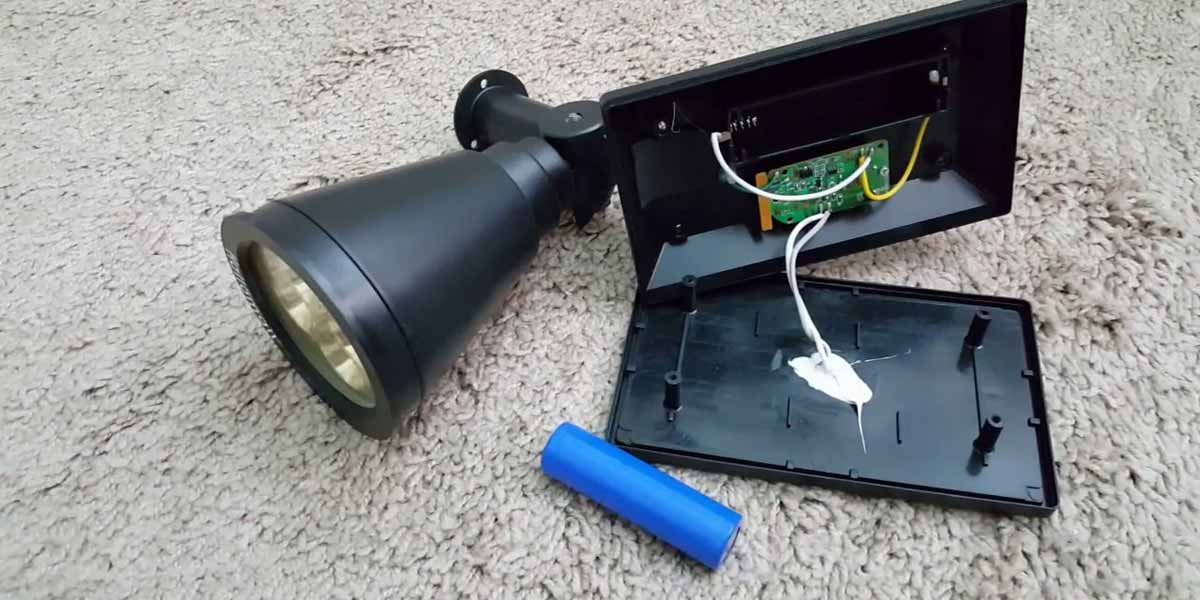
Some solar lights are sealed units: the cell sits in a welded or potted housing with no access panel, and when it dies the fixture is done. That is not always a scandal — a submersible or flush-mounted fitting has a reason to be sealed — but know which you are buying. Signs, in rough order of reliability:
- The listing says “built-in battery” or “integrated battery” and never names a size. A light with replaceable cells will tell you it takes AA, because that is a selling point.
- No battery model number in the specifications. “3.7 V 2000 mAh” with no format is a pouch or a welded pack.
- No screws on the underside or around the panel and no seam that opens. Ultrasonically welded housings show a faint continuous ridge instead of a gasket line.
- A very high IP rating on a very small fixture. IP67 or IP68 on something the size of a hockey puck usually means sealed for life.
- Thin, low-profile bodies. Flush-mount solar deck lights are the category most often built this way, because there is no room for a AA holder under a half-inch disc.
Our own pillar lantern is an honest example: a 3.7 V 2000 mAh built-in cell behind an IP68 seal. It stays dry in weather that would flood a screw-cap fixture, and you do not re-cell it at home.
Temperature quietly breaks winter charging
Every NiMH datasheet carries two temperature ranges, and the narrower one is for charging. Energizer’s NH15 AA lists a charge range of 0 °C to 40 °C — 32 °F to 104 °F — against a discharge range of 32 °F to 122 °F.
Read that with a garden in mind. A path light in Minneapolis in January is charged below freezing every morning for months; a black ABS spotlight in Phoenix in July passes 104 °F by mid-morning. Neither is instantly destructive, but Energizer notes that “operating at extreme temperatures, will significantly impact battery cycle life,” and it is a large part of why a cell that should give several years gives you two. Bringing decorative lights indoors for the coldest eight weeks helps — store them charged, switched off, cool and dry.
So what should you actually buy?
For most garden lights: a low-self-discharge NiMH AA or AAA from a manufacturer that publishes a datasheet, at a capacity within about double what came out. For a 600–800 mAh original, 900–1,300 mAh is the sweet spot. For a 1,200–2,000 mAh original, a standard 1,900–2,000 mAh eneloop-class cell.
Try one four-pack in a single light before you re-cell the yard. If it still underperforms with a fresh, known-good cell, the battery was never the problem — work through why solar lights stop working, or, if it has never worked since the box, check the pull-tab and the switch. If it charges but is simply dim, the constraint is the driver and the LED: see making solar garden lights brighter. Our pathway lights and step lights publish battery size and panel rating, so you can do the division above before you buy.
Sources
- Energizer - Alkaline Manganese Dioxide Handbook and Application Manual data.energizer.com Hydrogen generation under charging and the explicit warning about sealed or waterproof compartments; that charging a primary cell may cause explosion or leakage; and the 1.6V-to-0.9V sloping discharge curve
- Energizer - Nickel Metal Hydride Handbook and Application Manual data.energizer.com That rated capacity is determined at the five-hour 0.2C rate; that ordinary NiMH retains only 50-80% of capacity after twelve months of storage; that memory is a cadmium-electrode effect and no longer a NiMH concern; and the up-to-1,000-cycle figure
- Energizer NH15-2300 (HR6) AA datasheet data.energizer.com That 2300 mAh is measured at a 460 mA (0.2C) discharge; the 32-104F charging range against a wider 32-122F discharge range; and that operating at extreme temperatures significantly impacts cycle life
- Energizer - Cylindrical Primary Lithium Handbook (Li/FeS2) data.energizer.com The instruction to avoid charging because lithium iron disulfide batteries are not designed to be recharged, and why Li/FeS2 is a 1.5V system when most lithium chemistries are 3.0V
- Energizer L91 Ultimate Lithium AA datasheet data.energizer.com That the best AA on the shelf is a Li/FeS2 primary at 1.5V nominal - the same size as a NiMH AA and not rechargeable
- Panasonic Industry Europe - Ni-MH Batteries, Emergency Lighting mediap.industry.panasonic.eu The rating convention verbatim - charge at 0.1It for 16h, rest 3h, discharge at 0.2It to a 1.0V cutoff - under IEC 61951-2 (2017), which is why mAh figures are not comparable across brands
- Sanyo / Panasonic - eneloop specification sheet michaelbluejay.com Low-self-discharge retention of about 90% after one year and 70% after five, and the same IEC 61951-2 discharge convention stated explicitly
- Maxell ML2032 datasheet farnell.com The rechargeable Li-Al/manganese-dioxide coin cell at 3V nominal with a charge-voltage prohibited area - the basis for the CR versus ML versus LIR distinction in identically sized coin cells
- QX Micro Devices - QX5252 solar LED driver datasheet mikroshop.ch A 0.9-1.5V operating range described as suitable for a single AA or Ni-H cell; an integrated Schottky diode with no charge termination specified anywhere; the LED power law that goes as the square of cell voltage; and a 7V absolute maximum on the battery pins
- Panasonic Energy - eneloop lineup panasonic.com Current eneloop AA minimum capacity and cycle rating, and the claim of 70% capacity retained after ten years in storage
Questions people ask
Can I put regular AA batteries in my solar lights?
No. An alkaline AA fits, and the light will run for a night or two, but the panel has no charge controller - it pushes current into whatever is in the holder. Energizer's own handbook warns that charging an alkaline produces hydrogen, and that sealed or waterproof battery compartments make that a safety issue. A solar light compartment is sealed by design. Use 1.2 V NiMH.
Can I replace the battery in my solar lights?
Usually yes. Look for a screw cap or a panel that lifts off; most stake, path and step lights take a standard AA or AAA you can buy anywhere. Some lights cannot be re-celled: sealed pouch batteries, ultrasonically welded housings with no fasteners, and very thin flush-mount deck fittings. If the listing says 'built-in battery' and never names a size, assume it is sealed.
How long do batteries last in solar lights?
One to three years of nightly cycling is typical, and that is the cell, not the light - the LED will outlast several batteries. NiMH is rated for up to about 1,000 cycles under ideal lab conditions, but a solar light cycles it outdoors every single day, often charging below freezing or above 104F, which is outside the manufacturer's stated charging range and shortens life considerably.
How long will a regular alkaline battery last in a solar light?
Long enough to be tempting and not long enough to be worth it. An alkaline will run a garden light for a couple of nights, then dim steadily because its voltage slopes from about 1.6 V down to 0.9 V instead of holding the flat 1.2 V plateau a NiMH gives. More importantly, every daylight hour it spends in that holder is an hour of being charged, which it is not built to survive.
What is the best AA battery for solar lights?
A low-self-discharge NiMH from a maker that publishes a datasheet - Panasonic eneloop and its equivalents - at a capacity within roughly double what came out of the light. Ordinary NiMH keeps only 50-80% of its charge after a year on the shelf; eneloop-class cells hold far more. For a light that charges badly for half the year, that retention matters more than a bigger mAh number.
Do solar lights still charge if the switch is off?
On most designs, yes. The panel feeds the cell through a diode independently of the on/off switch, which sits between the battery and the LED driver - so the light charges while switched off and simply does not light at night. A minority of fixtures cut the whole circuit. If yours has been off for a season, leave it in the sun for two full days before deciding the battery is dead.
Do solar lights need direct sunlight to charge the battery?
They need direct sun to charge properly. Diffuse light on an overcast day produces a fraction of the panel's rated current, which means a partial charge and a short run time rather than no run time at all. A panel under tree shade, behind glass or facing north will keep a cell perpetually half-full, which looks exactly like a worn-out battery and is not.