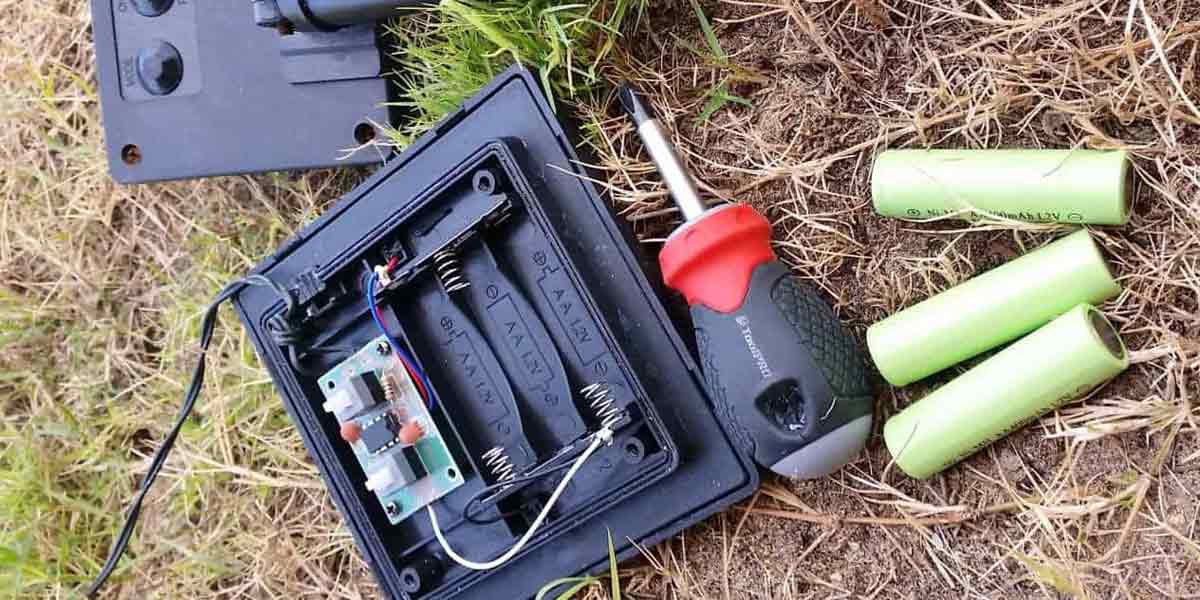
Yes, physically and electrically. A higher-capacity NiMH cell of the same size and the same 1.2 volts drops straight into the holder and nothing in the light objects. The useful question is whether it changes anything, and for most garden lights the answer is no — for a reason you can settle in your own yard tomorrow morning without buying a thing.
Do this before you spend $15 on batteries
Go outside an hour before sunrise and look at the light.
- Still lit? A bigger cell can help. Your light is reaching dawn with charge to spare, which means the panel banks a surplus, which means the cell actually reaches full — and everything below applies to you.
- Dark? A bigger cell will do nothing at all. The light ran the cell down before dawn. The cell was empty, not small. Doubling the size of a container you never fill changes nothing.
One caveat: some fixtures have a timer that shuts the LED off after six or eight hours whether or not there is charge left. If yours does, the pre-dawn test tells you nothing — check the switch positions first, which is also what that extra switch is usually for.
In our experience most stake, path and step lights fail this test from about September onward, and a good number fail it in July. That is the single most expensive misunderstanding in solar lighting: people buy capacity to solve a problem their light does not have.
The arithmetic, in three numbers
Everything here comes off the box, or off the panel with a multimeter.
Daily harvest (mAh) = panel current (mA) × peak sun hours × 0.7
Panel current is printed on the panel or in the manual. The commodity garden-light panel is 2 V 40 mA; better fixtures use 2 V 80 mA or 4 V 100 mA. Peak sun hours is your location’s daily solar energy, roughly 5 to 8 in summer and 0.8 to 3.4 in December depending on latitude. The 0.7 covers converter losses, charge acceptance and the fact that the panel is lying flat instead of aimed at the sun.
Nightly draw (mAh) = fixture current (mA) × hours of darkness
Surplus = harvest − nightly draw. That is the number that decides this question, and it is the number nobody publishes.
Work a real one. Garden Grove, California, mid-July: about 7.0 peak sun hours and 9.5 hours of darkness. A budget stake light with a 40 mA panel and a 15 mA draw harvests 40 × 7.0 × 0.7 = 196 mAh and spends 15 × 9.5 = 143 mAh. Surplus: 53 mAh a day. The stock 600 mAh cell tops up from half in about six days and then sits full.
Same light, Minneapolis, December: 1.36 peak sun hours gives a harvest of 38 mAh. The light burns all of it in two and a half hours and the cell never rises. Fit a 2,000 mAh cell and the surplus is still zero. You have bought a larger empty container.
What a bigger cell actually buys: a gentler charge
Here is the part the rest of page one misses entirely. A garden light has no charge termination. The commodity driver chips — QX5252, YX8018 — integrate a Schottky diode and over-discharge protection, and their datasheets describe no overcharge cutoff whatsoever. When the cell is full, nothing stops the panel. It keeps pushing all afternoon.
Energizer’s NiMH handbook is specific about what that costs:
Finally a maintenance (or trickle) charge rate of less than 0.025 C (C/40) is recommended. The use of very small trickle charges is preferred to reduce the negative effects of overcharging.
And, on what shortens a cell’s life: “effective control of overcharge exposure, time and charge rate is the way of enhancing battery life. Expected battery life is two to five years.”
Now do the division. A 40 mA panel into a full 600 mAh cell is C/15 — nearly three times Energizer’s recommended maintenance rate, for every sunny afternoon, for years. Put a 1,600 mAh cell in the same light and 40 mA becomes exactly C/40. The bigger cell has not stored more usable energy; it has turned an abusive trickle into a compliant one. That is the counterintuitive half of this question, and it is real.
| Panel on the fixture | Typical stock cell | Capacity for C/40 | Available as an AA NiMH? |
|---|---|---|---|
| 2 V, 40 mA — stake, step, deck | 300–600 mAh | 1,600 mAh | Yes |
| 2 V, 80 mA — pathway | 600–800 mAh | 3,200 mAh | No |
| 2 V, 100 mA — bollard, bright path | 800–1,200 mAh | 4,000 mAh | No |
Two of those three rows are impossible. No NiMH AA that genuinely delivers much over 2,500 mAh under IEC test conditions exists at consumer prices — anything above that on a marketplace listing is a claim about the test, not the cell. So above about 60 mA of panel current, there is no AA on the market that satisfies Energizer’s own maintenance limit. Those fixtures are outside the cell maker’s envelope by design, and no battery you can buy fixes that.
Where the crossover actually is
The C/40 target has a second problem: reaching it. Days to fill a C/40-sized cell from empty, with the LED disconnected entirely, works out to 40 ÷ (0.7 × peak sun hours). That cancels the panel out, which is why it is worth knowing:
- 7.0 peak sun hours (Southern California, July): 8 days of unbroken sun
- 5.5 peak sun hours (most of the US, summer): 10 days
- 1.36 peak sun hours (Minneapolis, December): 42 days
Eight to ten days of consecutive clear weather, with the light switched off. Switch it on and the surplus shrinks to a few tens of milliamp-hours a night, and it takes weeks. So the crossover exists, but it is narrow: a dusk-to-dawn light in a genuinely sunny summer climate, drawing 15 mA or less, on a 40 mA panel. That light will hold a 1,200–1,600 mAh cell full through July and August and will be charging it gently. The same light in Ohio in October will not.
The fixtures where sizing up wins outright are the ones that barely run: motion-sensor wall and security lights. A PIR wall lamp might draw 15 mAh across an entire night against a 300 mAh harvest. That cell fills in days, stays full, and spends the rest of its life being overcharged — which is exactly the case a larger cell fixes. Size those up freely. See solar wall lights and spot lights for the panel and cell ratings.
What goes wrong with a cell that never fills
Less than people fear, and this matters. Chronic partial charge is a performance problem, not a durability problem. Energizer lists the mechanisms that actually kill a NiMH cell — oxidation of the negative active material, deterioration of the positive active material — and both are driven by overcharge exposure and heat. Sitting at 40% state of charge is on neither list.
There is one real cost, and it scales with capacity: self-discharge. Energizer puts ordinary NiMH at “approximately 50% to 80% of their capacity after 12 months of storage,” and NiMH loses it front-loaded and faster when warm. That is a percentage, so a 2,000 mAh standard cell leaks more than three times the absolute milliamp-hours per day that a 600 mAh one does. On a December harvest of 38 mAh, a big standard cell’s own leakage can eat a quarter of everything the panel makes. This is why low-self-discharge matters more than capacity, and matters more the more capacity you buy.
The memory effect is a cadmium story
It comes up in every thread on this subject and it does not apply. The memory effect was a nickel-cadmium phenomenon, it amounted to roughly a 150 mV depression in the discharge voltage, and Energizer is explicit about where it came from: “the source of the effect is generally agreed to be in the structure of the cadmium electrode. With the elimination of cadmium in the nickel-metal hydride battery, memory is no longer a concern.”
So a part-charged NiMH cell is not learning bad habits, and it needs no conditioning, deep-cycling or break-in ritual — no manufacturer publishes such a procedure. What people mistake for memory is either a cell the panel never filled, or a worn cell, and the pre-dawn test separates the two.
Does a higher-capacity cell last more years? Yes — for an unexpected reason
Not because it stores more of what you use. Because it has more to lose.
IEC 61951-2 calls a NiMH cell finished when a check discharge at 0.2C runs under three hours — 60% of rated capacity. That is a relative threshold, but your light’s nightly demand is absolute: 150 mAh, every night, forever. A 600 mAh cell at its official end of life holds 360 mAh, and once ageing takes it below about 200 mAh you notice. A 2,000 mAh cell at the same 60% holds 1,200 mAh — twice what a brand-new stock cell holds — and could fall to 10% of rated before your light saw any difference.
Buy headroom, in other words, not runtime. One honest caution from the same handbook: Energizer names “battery capacity” first in its own list of factors affecting cycle life. The highest-capacity cell on the shelf is not the most durable one. A 2,000 mAh low-self-discharge cell will outlast a 2,800 mAh marketplace special in this application every time.
Can I fit a different size, and can I use lithium?
Size: match what came out. AA and AAA are not interchangeable even though plenty of holders grip either — an AAA gives roughly a third of the run time and an unreliable contact. Going the other way, a AA in an AAA holder does not fit at all. If a light takes several cells in series, replace all of them at once with the same brand, capacity and age; the weakest cell governs the string, and Energizer warns that mixing old and new or different makes “can cause rupture or leakage.”
Lithium: no, unless the light shipped with it. A 14500 lithium cell is the same 14.5 × 50 mm can as an AA at three times the voltage, and it will drop straight into an AA holder. The QX5252 driver is specified for 0.9 V to 1.5 V and sets LED power proportional to the square of cell voltage — feed it 3.7 V and the LED sees roughly ten times its design power. The chip often survives. The LED does not. The chemistry question is covered properly in what batteries solar lights need.
One more thing worth knowing about the compartment itself: Energizer’s design guidance says a NiMH battery cavity “should not be air tight,” because overcharge generates hydrogen and oxygen. A gasketed IP65 garden light is exactly an airtight compartment containing a cell that is overcharged every sunny afternoon. It is not a hazard at these currents, but it is a good illustration of how far outside the cell maker’s assumptions this whole product category sits.
So what should you actually buy?
If the light was dark before dawn: keep the stock capacity, buy low-self-discharge, and spend the effort on the panel instead. Cleaning it, moving it out of afternoon shade and tilting it south are worth more than any cell — at Minneapolis latitude, a 45-degree tilt more than doubles December collection. The full runtime model is in how long solar lights stay on at night.
If the light was still lit: size up, but modestly. One and a half to two and a half times stock is the range where the extra capacity is both reachable and useful — a 600 mAh original becomes 1,000–1,500 mAh, not 2,800. Buy from a maker that publishes a datasheet, and charge the new cell on a bench charger before it goes outside so the panel is not starting from zero.
And if you were hoping for more light rather than more hours, stop here: capacity cannot deliver it. LED current in these fixtures is set by the inductor in the boost converter, with no feedback loop and nothing else regulating it, so the cell’s size has no route to the brightness at all. That argument is worked through in making solar garden lights brighter. If the light has simply stopped working, start with the usual suspects before buying anything. Our pathway lights and step lights publish panel current and cell capacity on every listing, so you can run the surplus calculation above before you order rather than after.
Sources
- Energizer - Nickel Metal Hydride Handbook and Application Manual data.energizer.com The C/40 maintenance-charge limit verbatim; overcharge exposure as the controllable life factor and the two-to-five-year expected life; the memory effect traced to the cadmium electrode and its 150 mV depression; 50-80% retention after twelve months; the two NiMH degradation mechanisms; battery capacity listed among cycle-life factors; and the instruction that a battery compartment should not be air tight
- Energizer NH15-2300 (HR6) AA datasheet data.energizer.com That 2,300 mAh is rated at a 460 mA (0.2C) discharge, the 32-104F charge window against a wider discharge range, and that operating at extreme temperatures significantly impacts cycle life
- QX Micro Devices - QX5252 solar LED driver datasheet mikroshop.ch A 0.9-1.5V operating range, an integrated Schottky diode and over-discharge protection with no overcharge cutoff specified anywhere, and the LED power law that goes as the square of cell voltage - the basis for the 14500 warning
- YX8018 solar lawn lamp controller datasheet asset.conrad.com The second commodity driver, confirming the same architecture: charge control, boost drive and optical control on one chip with no charge termination described
- Panasonic Industry Europe - Ni-MH Batteries, Emergency Lighting mediap.industry.panasonic.eu The IEC 61951-2 rating convention - charge at 0.1It for 16h, rest, discharge at 0.2It to a 1.0V cutoff - which is what makes a marketplace mAh figure a claim about the test rather than the cell
- European Commission JRC - PVGIS re.jrc.ec.europa.eu The peak sun hour figures behind the worked examples: about 7.0 for Southern California in July, 5.5 as a US summer average, and 1.36 for Minneapolis in December
- Sigo Street Light - Myths of using higher mAh batteries in solar lights sigostreetlight.com The prevailing page-one answer this article corrects, and the primary citation behind Google's AI Overview on this query
- Sresky - Can I use a higher mAh battery in solar lights? sresky.com The 'brighter light output' claim being rebutted here, alongside the one correct caution on the whole SERP - that a cell too large to fill in a day harms battery life
Questions people ask
Can I use 600mAh instead of 300mAh in solar lights?
Yes, and this is the one upgrade that reliably pays. Doubling from 300 to 600 mAh keeps you well inside what a 40 mA panel can refill - roughly two and a half days of good sun from flat - and it halves the trickle rate into a full cell from C/7 to C/15. Buy a low-self-discharge cell at 1.2 volts in the same AA or AAA size, and pre-charge it before it goes outside.
Can I use 2000mAh instead of 600mAh?
It will fit and it will not damage anything, but on a typical garden light it will never fill. A 40 mA panel banks roughly 150-200 mAh on a good summer day and the light spends most of that overnight, so the surplus is tens of milliamp-hours. Filling 2,000 mAh at that rate takes weeks of unbroken sun. You get the same runtime you had, for four times the money.
Can I use 1000mAh instead of 600mAh?
Yes - this is close to the sweet spot. One and a half to two and a half times the stock capacity is reachable by a small panel in summer and meaningfully reduces the overcharge rate into a full cell. It will not extend runtime unless your light is already still lit at dawn, but it does give the cell far more capacity to lose before you notice it ageing.
Can I use a 3000mAh battery instead of 2000mAh?
Be careful what you are buying. No NiMH AA that genuinely delivers much over 2,500 mAh under IEC 61951-2 test conditions exists at consumer prices, so a 3,000 mAh AA listing is usually a claim about a slower test, not a bigger cell. If the original really was 2,000 mAh, the fixture is a lithium or multi-cell design - match the label you removed rather than the shape.
Will a higher mAh battery make my solar light brighter?
No, and nothing about capacity can. In these fixtures the LED current is set by the inductor in the boost converter - there is no resistor, no feedback loop and no dimmer, so nothing in the circuit responds to how much charge the cell holds. A bigger cell can only extend how long the light runs, and only when the light was reaching dawn with charge left over.
Can I put a lithium battery in a solar light instead of NiMH?
Only if the light shipped with lithium. A 14500 lithium cell is AA-sized at 3.7 volts against the 1.2 volts these drivers expect, and the common QX5252 chip sets LED power proportional to the square of cell voltage - roughly ten times the design power. The driver usually survives; the LED does not. Match the chemistry printed on the cell you removed.
Does a higher mAh battery take longer to charge?
Yes, proportionally, and that is the whole problem. Divide capacity by panel current for a rough figure: 600 mAh on an 80 mA panel is about 7.5 hours of full sun, while 2,300 mAh on the same panel is about 29 hours - four or five clear California days, and in a Michigan January possibly never. A cell that never fills gives you no more runtime than the one it replaced.