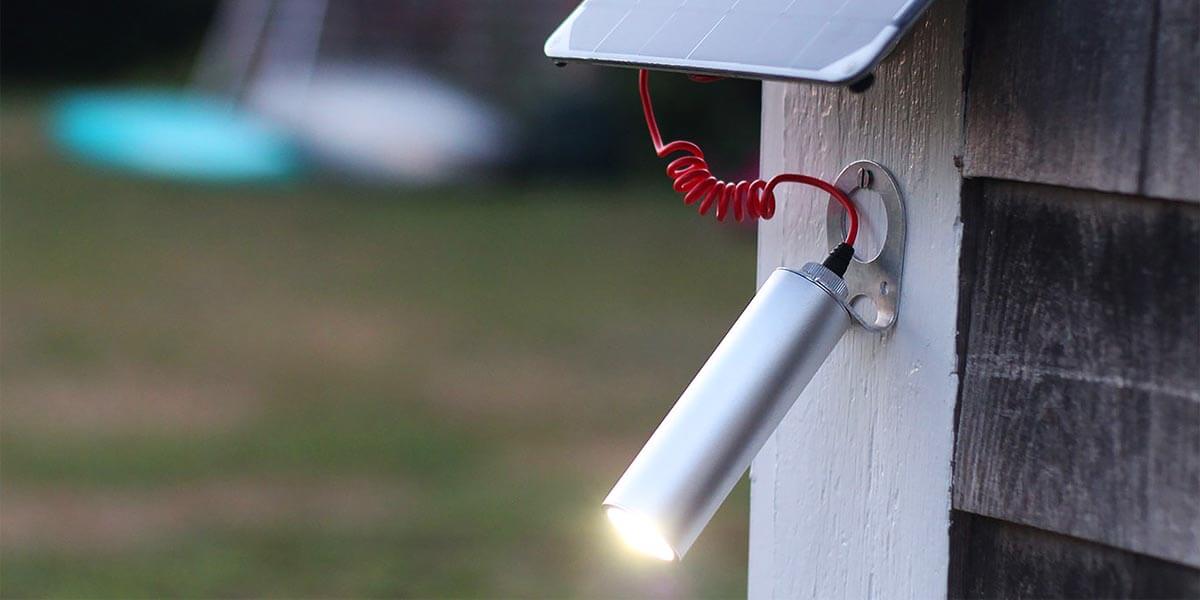
A solar garden light lasts as long as its battery, and its battery lasts one to four years. Everything else in the fixture outlives that by a wide margin — the LED by roughly a decade, the solar cell by longer still. So the honest version of “how long do solar lights last” is: the light is a three-dollar battery wearing a twenty-dollar costume, and the only question that changes the answer is whether you can get the battery out.
Here is the breakdown, with where each number comes from. This article is about lifespan in years; if you want to know why a light that worked last month now quits at 11 p.m., that is a different problem and we cover it in how long solar lights stay on at night.
| Component | Realistic service life | Basis |
|---|---|---|
| NiMH cell (AA/AAA) | 1–4 years | Energizer: “expected battery life is two to five years”; cycle-life standard below |
| LED die | 12–17 years | 25,000–50,000 h at ~2,900 h/yr of night running |
| Driver IC | Longer than the housing | Rated −40°F to +185°F; fails only when water reaches it |
| Lens / housing plastic | 2–6 years to visible yellowing | No UV cap layer on molded parts |
| Panel encapsulant | 3–8 years | Epoxy potting; fails by moisture corrosion, not sunlight |
| Seals and contacts | 2–5 years | Daily thermal cycling, which no IP rating tests |
The battery’s clock is set by a standard you can look up
NiMH cycle life is not a marketing number. It is defined by IEC 61951-2, clause 7.5.1.4, and the definition matters more than the count: the cell is considered finished when a checkup discharge at 0.2C runs for less than three hours. That works out to 60% of the cell’s rated capacity. A 600 mAh AA is “dead,” by the standard’s own definition, at 360 mAh.
How many cycles gets you there? The European Commission’s Joint Research Centre ran the test on off-the-shelf consumer cells in 2025 and reported that the pass mark for an AAA is 200 cycles, with commercial cells typically coming in 25–30% better than the standard requires — call it 250 to 260. Energizer’s own application manual puts the ceiling at “up to one thousand cycles” and then says plainly that this is “under ideal controlled conditions,” and that real-world factors cut it.
Now apply the arithmetic that no competing article does. A garden light performs one charge-discharge cycle per day, 365 a year. It does not rest. At 250 cycles you are out in eight months; at 1,000 you are out in two years and nine months. Real lights land between those because they rarely run the cell flat — a summer night doesn’t fully discharge it, and partial cycles are gentler. That is why Energizer’s stated expectation, “two to five years,” and Gama Sonic’s own customer-facing figure, “most batteries have a 2-3 year life expectancy,” agree with each other and with what you see in your own yard.
Energizer also sets a hard ceiling independent of use: “battery life is limited to 5 years or less.” No brand escapes this, because every brand buys the same cells. Solar battery lifespan is the same story at larger scale.
Your light’s charging circuit is shortening that life on purpose
This is the part nobody writes about. Open a pathway light and you will find a four- or six-pin chip — almost always a QX5252 or a YX8018, the two commodity parts that run this entire product category. Read their datasheets and you find charge control, boost drive, light-level switching and over-discharge protection. Neither datasheet describes a charge-termination or overcharge cutoff. When the battery is full, nothing stops the panel.
Energizer is specific about why that matters: a maintenance or trickle charge should be held below 0.025C — C/40 — because “the use of very small trickle charges is preferred to reduce the negative effects of overcharging,” and “maintenance of full charge currents for extended periods once the battery has reached full charge can reduce life.”
A typical single-cell path light uses a 2 V panel with a short-circuit current around 40–60 mA, and the battery clamps the panel’s voltage well below its open-circuit value, so it runs close to short circuit. Against a 600 mAh cell that is C/15 to C/10 — three to four times Energizer’s recommended maintenance rate. A light that gave up roughly 160 mAh overnight refills in about four hours of good sun, then spends the rest of a clear California afternoon being pushed at C/15 with nowhere for the energy to go. Across a year that is on the order of 1,000 to 2,000 hours of overcharge.
That single design decision is why garden-light batteries sit at the short end of Energizer’s 2-to-5-year range instead of the long end. It is also why a bigger cell helps less than people expect — see using a higher-mAh battery in solar lights.
The LED is not what fails, and one popular claim has it backwards
A page-one result for this keyword states that LED bulbs “typically need replacement every one to three years” while solar panels last 30–35. That is inverted, and the Department of Energy’s data says so.
The DOE and the Next Generation Lighting Industry Alliance define luminaire lifetime as B50/L70 — the point at which half the population has dropped below 70% of initial light output, from any cause. Their Hammer Test subjected LED luminaires to temperature shock from −58°F to 257°F, plus 185°F at 85% humidity, plus hourly power cycling. The 611 LEDs in those fixtures accumulated close to a million cumulative hours of that abuse and produced four failures — under 1%. The report’s conclusion: “Catastrophic failure of LED package failures continues to be rare in testing,” and “the failures that were observed typically occurred in the driver circuit.”
Run the hours. A light on from dusk to dawn averages about 8 hours a night, or 2,920 hours a year. A 25,000-hour LED is a 9-year part. A 50,000-hour LED is a 17-year part. One caution on that headline number: IES TM-21 limits a reported lumen-maintenance projection to six times the LM-80 test duration, so even a full 6,000-hour test only supports a 36,000-hour claim — about 12 years. And the LEDs in a $12 pathway light are almost never LM-80 tested at all, so treat “50,000 hours” on the box as a category figure rather than a measurement of that product. It is still ten times the battery.
What actually kills the light: plastic and water
The lens and the housing
Outdoor polycarbonate earns its ten-year warranty against UV discoloration from a co-extruded UV cap layer. Plaskolite, which makes TUFFAK sheet, lists standard grades explicitly as “not UV stabilized” and reserves the long outdoor life for capped product. A molded garden-light globe has no cap layer — it relies on UV absorber blended into the resin, which is consumed over time. The DOE lifetime guide names the consequence directly: “yellowing of some polymeric optical components may occur and contribute to lumen depreciation and color shift.”
The practical effect is a light that looks dimmer while its battery and LED are fine. It is not always permanent; see cleaning yellowed plastic on solar lights.
The panel
A rooftop module lasts 25 years because it is a glass-fronted, EVA-laminated, aluminum-framed assembly with a written power warranty. The two-inch cell on your stake light is a chip of silicon under poured epoxy. They are not the same object and the 25-year figure does not transfer — that comparison belongs on how long solar panels last, not here.
What fails on a potted mini-module is instructive. Vincent et al., testing amorphous-silicon mini-modules under sequential UV and damp-heat stress, reported that the main cause of degradation was corrosion created by moisture — not sunlight. The panel on your light usually dies because water got under the potting, not because the cell wore out. Which is also why keeping the panel clean buys output but not immortality.
The seal
Here is the under-reported one. IP ratings are tested under IEC 60529 as short water-spray or immersion tests at constant temperature. No IP test simulates daily thermal cycling — and thermal cycling is exactly what gets water into a garden light. The sealed head heats in the afternoon, the air inside expands and vents past the gasket, then it cools after sunset, draws humid air back in, and condenses. That is why you find fog inside a light that was never rained on hard, and why the battery contacts corrode green from the inside. An IP65 badge is real protection against a hose. It is not a claim about year three.
The driver IC
The QX5252 is rated for −40°F to 257°F operation and 2,000 V of ESD; the YX8018 is rated −40°F to 185°F. Even a dark plastic head baking in Palm Springs stays inside those limits. The chip does not age out. It dies when water reaches the board, which makes it a symptom of the seal, not a separate clock.
What a battery swap buys you — and what it doesn’t
A fresh AA NiMH costs about $2.50 in a four-pack and takes two minutes. Against a $20 fixture that is an easy call, and it is the single highest-value maintenance action available. But it fixes exactly one failure mode.
| Symptom | Does a new battery fix it? |
|---|---|
| Runs 3 hours instead of 10 | Yes — this is the 60%-capacity endpoint arriving |
| Dim but runs all night | No — yellowed lens or dirty panel |
| Flickers, then quits | Usually no — corroded contacts or a wet board |
| Dead after rain, fog inside | No — the seal has failed; the battery is a casualty |
| Never worked out of the box | No — see brand-new solar lights not working |
| Works in summer, quits in December | No — short days, low sun angle |
The swap also does not reset the housing’s clock. A light on its third battery is a five-year-old light with a five-year-old lens and a five-year-old gasket, and those are the parts you cannot buy. Full diagnostic sequence is in solar lights not working.
One correction on winter storage, which every article recommends and most explain wrongly. Cold does not kill NiMH — Energizer’s own recommended storage range runs to −4°F. What kills it is being stored discharged and under load: “extended storage with a load connected … may also cause chemical changes after the battery is discharged, which may be difficult or impossible to reverse.” So bring the lights in charged, and either pull the cell or use the switch. That is what the on/off switch on solar lights is actually for.
Nobody publishes field failure data for these
We looked. There is no public dataset of field failure rates for consumer solar garden lights — not from a retailer, not from a brand, not from a national lab. The two nearest things cover other products. IEC TS 62257-9-8, administered through VeraSol, is the only internationally recognized quality standard for solar lighting, and it governs off-grid pico-solar lanterns and home systems, not decorative path lights sold at US retail. The DOE’s Hammer Test and CALiPER program cover mains-powered LED luminaires. Your pathway light is tested by nobody.
That leaves warranty length as the only published proxy, and it is a useful one, because a warranty is a company’s own bet on its failure curve. Gama Sonic warrants residential products for 2 years and selected commercial products for 5 — and separately tells customers that “most batteries have a 2-3 year life expectancy.” When the residential warranty and the battery’s expected life are the same number, you are being told where the company thinks the product ends.
How to buy so the answer is “as long as I want”
One specification outranks everything else: can you replace the battery with a standard cell, using a screwdriver, without breaking anything? A light with a gasketed battery door and a plain AA or AAA NiMH inside is a fixture you can keep alive for a decade for the price of a coffee a year. A light with an ultrasonically welded head, a soldered tab, or a proprietary lithium pack is a disposable item with a 1-to-3-year clock, whatever the box says. Check this before price, before lumens, before IP rating. See do solar lights need batteries for what to look for inside.
After that: fewer, larger fixtures outlast many small ones, because larger heads have room for a real gasket and a proper cell. Our solar pathway lights and solar spot lights are picked on that basis. And if your existing lights are simply dim rather than dead, start with making solar garden lights brighter before you replace anything.
Sources
- Energizer - Nickel Metal Hydride Handbook and Application Manual data.energizer.com Expected battery life of two to five years and a hard ceiling of five years; up to 1,000 cycles only under ideal controlled conditions; the 0.025C trickle limit; overcharge and storage-under-load as the life-limiting mechanisms
- Quintero Pulido, Covrig & Bruchhausen (EC Joint Research Centre), Batteries 11(1):30, 2025 mdpi.com The IEC 61951-2 endurance method, its three-hour / 60%-of-rated-capacity end-of-life criterion, the 200-cycle AAA pass mark, and commercial cells running 25-30% above the standard
- Next Generation Lighting Industry Alliance & US DOE - LED Luminaire Lifetime: Recommendations for Testing and Reporting nglia.org The B50/L70 definition; the Hammer Test result of four failures across 611 LEDs and roughly a million cumulative stress-hours; that failures occur in the driver circuit; polymer yellowing as a cause of lumen depreciation; the roles of LM-80 and TM-21
- QX5252 solar LED driver datasheet mikroshop.ch 0.9-1.5V operation, over-discharge protection and the operating temperature range - and the absence of any charge-termination function
- YX8018 solar lawn lamp controller datasheet asset.conrad.com Charge control, boost drive and optical control on one chip, with no overcharge cutoff described anywhere in it
- Plaskolite - TUFFAK Polycarbonate Sheet Fabrication Guide plaskolite.com That the ten-year warranty against UV discoloration applies only to UV-capped sheet, and that standard grades are listed as not UV stabilized
- Vincent et al. - EPJ Photovoltaics 14, 2023 doi.org Degradation of amorphous-silicon mini-modules under sequential UV and damp-heat stress, with moisture-driven corrosion identified as the main cause
- Gama Sonic - warranty and FAQ gamasonic.com A 2-year residential and 5-year selected-commercial warranty alongside the company's own statement that most batteries have a 2-3 year life expectancy
Questions people ask
Why do solar lights stop working so quickly?
Almost always the battery. NiMH cells in garden lights complete a full charge-discharge cycle every single day, roughly 365 a year, and the charging circuit has no overcharge cutoff - it keeps pushing current at three to four times the manufacturer's recommended maintenance rate all afternoon once the cell is full. Energizer expects two to five years from a NiMH cell; a garden light lands at the short end of that range.
Do outdoor solar lights wear out?
Yes, but unevenly. The LED is a 12-to-17-year part and the driver chip outlasts the fixture. What wears out is the battery, in one to four years; the lens plastic, which yellows in two to six seasons without a UV cap layer; and the seal, which fails from daily heating and cooling rather than from rain. Two of those three are not repairable at home.
Can you replace the battery in solar lights?
On some lights, yes, and it is the single best thing you can do for them. Look for a gasketed battery door holding a standard AA or AAA NiMH cell, replaceable for about $2.50 in under two minutes. Lights with ultrasonically welded heads, soldered battery tabs, or proprietary lithium packs cannot be serviced and are effectively disposable after one to three years.
How long do solar light batteries last?
One to four years in normal use. IEC 61951-2 defines a NiMH cell as finished when it holds 60% of rated capacity; consumer cells reach that in roughly 250 cycles by the standard's pass mark, or up to 1,000 under ideal lab conditions. At one cycle per day that is eight months to under three years. Energizer caps calendar life at five years regardless of use.
What is the downside of solar lights?
The battery sets the ceiling, and you cannot buy your way past it - every brand uses the same NiMH cells with the same one-to-four-year clock. Output also drops with short winter days and low sun angles. The upside is that the failure is cheap and predictable: a $2.50 cell restores a $20 fixture, provided the manufacturer let you open it.
Are you supposed to leave solar lights on all the time?
During the season, yes - the daily cycle is what they are built for. Over winter storage, no. Energizer warns that storing a NiMH cell discharged and under load can cause chemical changes that are difficult or impossible to reverse. Bring lights in fully charged, then either switch them off or remove the battery. Cold itself is not the problem; sitting flat is.
Do solar lights last longer if you bring them in for the winter?
Modestly, and only if you do it correctly. Charge them fully first, then remove the cell or use the off switch so nothing draws on it. Storing them discharged with the circuit connected does more damage than leaving them outside would. The other benefit is UV: four months out of the sun is four months your lens plastic is not yellowing.