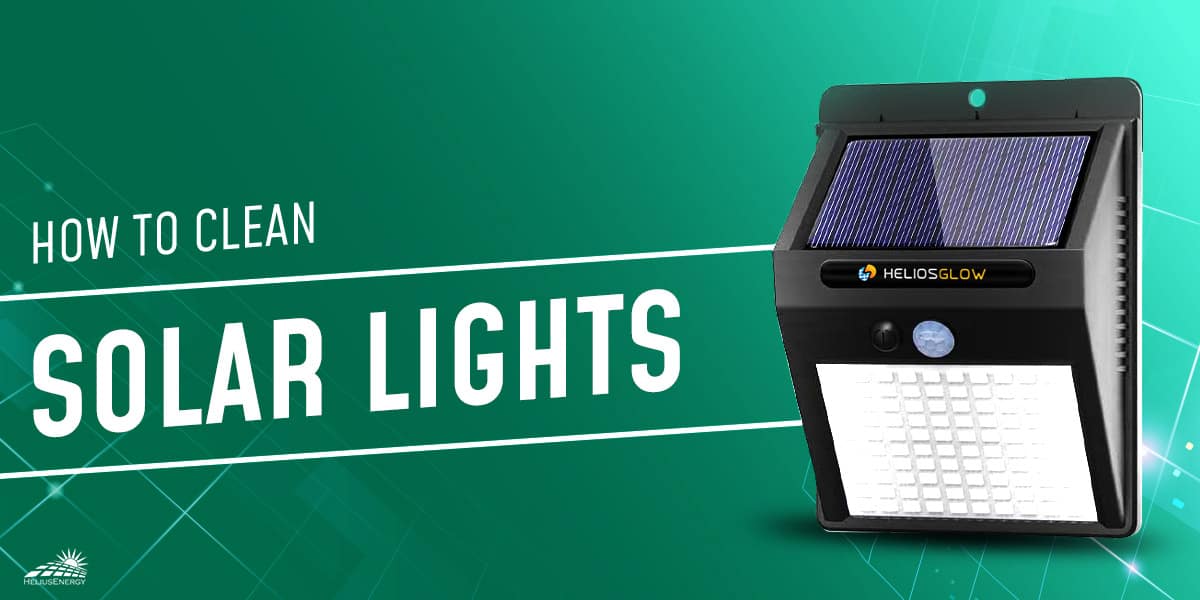
Use warm water, a drop of mild dish soap, and a microfiber cloth. Wipe the panel, rinse the soap off, and dry it immediately so minerals in your tap water don’t leave a film. That’s the whole job, and it takes about ten minutes for a set of six.
The harder question is whether dirt was ever your problem. A solar light that has gone dim has four plausible causes, and only one of them is fixed by cleaning. Work out which one you have before you spend a Saturday on it.
Start here: is it actually dirt?
Do this in daylight, and it takes thirty seconds. Cup your hand tightly over the solar panel to block all light. A working light should switch on within a few seconds. Then look at what you learn:
| What happens | What it means | What to do |
|---|---|---|
| Lights up bright under your hand | LED, sensor and battery all work. Dim nights mean it isn’t charging. | Clean the panel. Then check for new shade. |
| Lights up weak and fades fast | Battery is worn, not dirt. | Replace the cells. |
| Nothing at all | Dead battery, failed sensor, corroded contacts, or the switch is off. | Open the housing and work through the causes. |
| Fine for 2 hours, then out | Partial charge. Could be dirt, shade, short winter days, or an aging battery. | Clean first, then reassess after three sunny days. |
One more check before you blame the panel: solar lights cycle their battery once every single day. Nickel-metal hydride cells typically fall to 70–80% of rated capacity after roughly 300–500 cycles, which is between one and one and a half years of ordinary use. If your lights are on their third summer and dimming, the battery is the likeliest answer and no amount of scrubbing will touch it. Our guide to how long solar lights last covers what to expect from each component.
If the lights are brand new and behaving badly, check whether the protective film is still on the panel and whether there’s a plastic pull-tab in the battery compartment. Both are extremely common, and both look exactly like a defective product. We cover that separately in brand new solar lights not working.
What dirt actually costs a garden light
Less than the internet claims, but in a way that hurts more. NREL’s PVWatts calculator uses a 2% default soiling loss for US systems, and real-world annual losses generally land around 5%, reaching 7% in dusty regions. Accumulation runs roughly 0.01% to 0.5% per day between rainfalls.
Those numbers come from rooftop arrays, and there are two reasons your path lights do worse.
They’re mounted flat. Soiling research consistently finds that tilt drives self-cleaning: modules need roughly 10–15° before rain reliably rinses them, and flat-mounted panels both collect more and shed less. The panel on a typical stake light sits at or near 0°. Rain doesn’t clean it. Rain lands on it, evaporates, and leaves behind whatever it picked up on the way down.
The energy margin is thin. A rooftop array losing 5% produces 5% less and nobody notices. A garden light has to bank enough charge during the day to run all night, and the daily surplus is small. Once soiling eats that surplus, runtime doesn’t dim gently — it falls off a cliff. This is why a lightly hazed panel can turn an all-night light into a two-hour light. We’d rather flag that as a mechanism than invent a percentage for it, because nobody has published measurements on garden-light-class panels.
The other half of the equation is placement, not cleanliness. A spotless panel in a spot that gets four hours of winter sun will still underperform. If you’re troubleshooting seasonally, start with whether your lights get enough direct sun.
The ten-minute method
You need warm water, one drop of mild dish soap per quart, two microfiber cloths, and a soft brush — an old toothbrush is fine for seams. That’s it. No specialty products.
- Switch the light off if it has a switch, and work in the shade or early evening. Not because of thermal shock (see below), but because a hot panel flash-dries your rinse water and leaves mineral spots.
- Brush off loose debris dry. Pollen, grit and cobwebs come off easily before water turns them into abrasive slurry.
- Wipe the panel with a damp, soapy cloth. Wrung out, not dripping. Light pressure. Grit dragged under pressure is what actually scratches these panels.
- Rinse the soap off with a second cloth and clean water. Every PV manufacturer that permits detergent also requires a rinse.
- Dry immediately with a dry microfiber. This is the step everyone skips and the one that prevents hard-water spotting.
- Clean the lens and housing the same way, keeping water away from the battery compartment seam.
Two things not to do. Don’t use a hose or pressure washer: most garden lights are rated IP44, meaning splash-resistant, and pressurised water can push past seals that handle rain fine. Water inside the housing corrodes solder joints and is far more likely to kill the light than dirt ever was. And don’t submerge anything. For a deeper walkthrough of panel-only cleaning, see cleaning the solar panel on garden lights.
What should never touch your solar lights
This is where most advice online goes wrong, including advice from large sites. The lenses and housings are polycarbonate or ABS, and polycarbonate has specific, documented chemical enemies.
| Product | Verdict | Why |
|---|---|---|
| Windex / ammonia glass cleaner | Never | Covestro rates 0.1% ammonia as non-resistant on Makrolon; Polyvantis rates 0.13% ammonium hydroxide “poor” on Lexan. Windex Original contains ammonium hydroxide, monoisopropanolamine and a glycol ether — three separate species that attack polycarbonate. |
| Acetone / nail polish remover | Never | Swells polycarbonate; explicitly prohibited on both Lexan and acrylic. |
| Toothpaste, baking soda, scouring powder | Never | Abrasive. It polishes away the thin UV-stabilised skin, which is why the haze comes back faster the second time. |
| Sandpaper on a panel | Never | The panel surface is the encapsulant. Sanding it destroys the panel. (On corroded metal battery contacts, fine grit is acceptable.) |
| WD-40 | No | A water-displacing lubricant, not a cleaner. Leaves a film that collects dust. |
| Pressure washer | No | Exceeds the IP rating. Drives water past gaskets. |
| Isopropyl alcohol | Situational | Contrary to popular advice, pure IPA is rated resistant on polycarbonate. But it crazes stressed acrylic, and Lexan’s own bulletin says not to use alcohols on UV-protected surfaces. Not worth the risk on a lens; fine on battery contacts. |
| Vinegar | Situational | Safe on polycarbonate (10% acetic acid rates resistant). Genuinely useful on alkaline battery leakage. But no PV maker endorses it on panels — First Solar specifies pH 6.5–8.5 and household vinegar is around pH 2.4. |
| Mild dish soap, diluted | Yes | Polycarbonate makers name Joy and Palmolive by brand as compatible. Dilute it: neat Dawn runs pH 8.7–9.3. |
One myth worth retiring: cold water cracking a hot panel. The 372,000-character NREL/Sandia best-practices guide for PV operations contains zero mentions of thermal shock. Some module makers do warn about it — First Solar caps water at 20 °C from module temperature — but that guidance is about large tempered-glass modules. Your garden light has no glass at all. Clean when cool for the sake of spotting and your own comfort, not because the panel will crack.
Hard-water spots, and why vinegar won’t shift them
White spots left after cleaning aren’t kettle scale. On an unheated outdoor surface the deposit forms by evaporation, and it contains calcium, magnesium, sodium and — critically — silica. Municipal water testing has found silica at under 3 ppm in the water making up 10–30% of the residue left behind.
That matters because calcium salts dissolve in any weak acid, and amorphous silica does not. It stays un-ionised below about pH 9, so vinegar and lemon juice simply don’t touch it. This is why the standard advice fails and people escalate to scrubbing, which scratches the plastic. What reads as “etched” on a solar light is almost always deposit plus scrub marks, not true etching — plastics have no silica network to etch.
The fix is prevention. Testing shows that wiping a surface dry immediately after wetting produces no staining at all. If spots have already formed, distilled water plus patience, and never a squeegee or scraper on polycarbonate. If your sprinklers hit the lights, move a head — sprinkler overspray is the single biggest source of spotting on an American lawn.
When cleaning can’t help: yellowed panels and hazed lenses
These are two different failures and only one is worth your time. There is a third, which the wet-finger test below separates from both.
A yellowed panel is finished. The small panels in garden lights are usually solar cells potted in epoxy resin on a circuit board, not glass modules. Standard epoxies are not UV-stable. Supplier data puts light transmittance at 85–88% when new, falling to around 70% within about two years outdoors, with visible yellowing. That is bulk degradation through the resin, not a film on top. No cleaner reaches it, no polish removes it, and clear lacquer makes it worse — ordinary lacquers block large fractions of the blue and UV your cell needs. If the panel itself has gone amber and the light is two-plus years old, replace the light or the panel.
A crazed panel surface is a different thing, and that one you can fix. Rub a wet finger across the panel. If the cloudiness vanishes while wet and returns as it dries, you are not looking at bulk yellowing at all — you are looking at microscopic UV cracks in the surface resin scattering light back out, and the water is temporarily filling them. A thin coat of water-clear lacquer does the same thing permanently, which is why the advice above does not apply here: on a crazed surface a coating removes more scatter than it adds absorption. On an amber panel it only adds absorption. The distinction is the wet finger, and the method is in making solar garden lights brighter.
A hazed plastic lens can be restored, temporarily. Yellowing in polycarbonate is a surface phenomenon roughly 25 micrometres deep, because that’s as far as UV penetrates. You can sand and polish it out — the same process as headlight restoration kits. Consumer Reports tested those kits and found they genuinely work, but that the haze returns noticeably within about a year. The reason is that polishing removes the UV-protected outer skin along with the yellowed layer — and, on a headlight, the factory hard coat with it. A moulded garden-light globe usually has no hard coat at all; it relies on UV absorber blended into the resin, which is concentrated in and consumed from that same outer skin. Either way what you expose underneath is bare, unprotected plastic. If you restore a lens, seal it afterwards with a UV-blocking clear coat, or you’ll be doing it again next summer. Full method in restoring yellowed plastic solar lights.
Battery contacts, corrosion, and one common mistake
White crusty residue on the battery terminals is leaked electrolyte. In both alkaline and NiMH cells that electrolyte is a strong base, so a mild acid neutralises it: a few drops of white vinegar on a cotton swab, then a dry brush, then wipe clean and dry thoroughly. Fine abrasive on the metal contacts is fine here — they’re metal, not optics.
The mistake: do not put alkaline batteries in a solar light. Alkaline cells aren’t designed to be recharged. The panel can’t meaningfully charge them, they run briefly, and then they leak and corrode the terminals you just cleaned. Replace with rechargeable NiMH cells at the same size and a matching or higher mAh rating. If your lights are sealed with an internal lithium cell, there’s nothing user-serviceable inside.
Once the cells are healthy again, a few other adjustments will get more out of them, and if the light still won’t switch on at dusk the photoresistor is the next suspect — see fixing a solar light sensor.
How often to clean, by climate
Every six months is the common recommendation and it’s too vague to be useful. Cleaning frequency is driven by what settles on the panel where you live.
| Region / condition | Suggested interval | Main soiling source |
|---|---|---|
| Desert Southwest | Monthly | Fine dust, long dry spells, almost no rain rinsing |
| Southeast, spring | Every 2–3 weeks in pollen season | Pollen, which forms a sticky film |
| Coastal (either coast) | Monthly | Salt film, which attracts and holds moisture |
| Pacific Northwest | Every 2–3 months | Algae and biofilm, not dust |
| Northeast / Midwest | Every 2–3 months, plus spring | Road salt spray, winter grime |
| Anywhere with sprinklers | Monthly | Hard-water spotting |
| Any region, after a storm | Once | Splashed mud and debris |
Add one rule that beats any schedule: clean when the panel looks dull, and check after anything unusual. A single bird dropping matters far more than uniform haze, because it blocks one cell completely and the cells are wired in series.
What to expect afterwards
Give it three sunny days before you judge. A deeply discharged battery won’t recover in one afternoon, so a light that seems unimproved the first night may be fine by the third. If three good days produce no change, cleaning wasn’t the answer — go back to the test at the top of this page.
And in winter, no amount of cleaning compensates for short days and a low sun angle. That’s a charging problem, and we cover the options in charging solar lights without direct sun. If a fixture is genuinely past saving, our solar pathway lights and solar spot lights ship from Garden Grove, California.
Sources
- NREL - PVWatts Version 5 Manual osti.gov The 2% default soiling loss assumption for US PV systems
- NREL / Sandia / SunSpec - Best Practices for Operation and Maintenance of Photovoltaic and Energy Storage Systems, 3rd Edition osti.gov Demineralised water and mild detergent; no pressure washing, solvents or abrasives — and no thermal-shock warning anywhere in it
- Covestro — Makrolon chemical resistance solutions.covestro.com 0.1% ammonia non-resistant; 10% acetic acid and pure isopropanol resistant; the aminolysis mechanism
- Polyvantis — LEXAN Sheet cleaning instructions (2025) polyvantis.com Prohibits abrasives, alkaline cleaners and acetone; names compatible dish soaps
- The Madison Group — Yellowing of Polycarbonate madisongroup.com Yellowing is a surface phenomenon roughly 25 µm deep, limited by UV penetration
- Consumer Reports — Do headlight restoration kits really work? consumerreports.org Polishing restores hazed polycarbonate but haze returns within about a year without a new UV coat
- USGS Water Science School - Hardness of water usgs.gov Hard-water spotting is evaporative deposit, not etching; silica is the acid-insoluble fraction
- SC Johnson — Windex Original ingredient disclosure whatsinsidescjohnson.com Confirms the ammonium hydroxide, monoisopropanolamine and glycol ether content
Questions people ask
What is the best thing to clean solar lights with?
Warm water with a single drop of mild dish soap, applied with a microfiber cloth, then rinsed and dried immediately. Polycarbonate manufacturers name common dish soaps as compatible, and PV module makers permit mild detergent provided you rinse it off. Dilute it — undiluted dish soap is more alkaline than some module specs allow. You do not need a specialty solar panel cleaner, and most of them cost more than the light.
Can you use Windex on solar lights?
No. Windex Original contains ammonium hydroxide, monoisopropanolamine and a glycol ether, and all three attack polycarbonate. Covestro rates ammonia at just 0.1% as non-resistant on its Makrolon polycarbonate. The damage is not stress cracking as commonly claimed — ammonia chemically breaks down the polymer itself, which happens whether the part is stressed or not. Use soapy water instead.
How often should you clean solar lights?
It depends far more on where you live than on a calendar. Monthly in the desert Southwest, on the coast, or anywhere sprinklers hit them. Every two to three months in the Pacific Northwest, Northeast and Midwest. Every two to three weeks during Southeast pollen season. Because garden light panels sit flat rather than tilted, rain does not self-clean them the way it does rooftop arrays.
How do I make my cloudy solar lights clear again?
First work out which part is cloudy. A hazed plastic lens can be sanded and polished clear — the yellowing is only about 25 micrometres deep — but you must seal it with UV-blocking clear coat afterwards, or it hazes again within a year. A yellowed panel is different: that is the epoxy encapsulant degrading throughout, and it cannot be restored. Replace the panel or the light.
Can you use vinegar to clean solar panels?
On the plastic housing, yes — dilute acetic acid is rated safe on polycarbonate. On the panel itself, no manufacturer endorses it, and First Solar specifies cleaning solutions between pH 6.5 and 8.5, while household vinegar sits near pH 2.4. Vinegar is genuinely useful for one job though: neutralising the alkaline crust left by a leaking battery.
Does cold water crack a hot solar panel?
Almost certainly not, on a garden light. NREL and Sandia’s operations guide for PV systems does not mention thermal shock at all. Some large-module manufacturers do warn about it, but that guidance concerns tempered glass — and garden lights generally have no glass. Clean when the panel is cool anyway, because hot panels flash-dry rinse water and leave mineral spots.
Why are my solar lights still dim after cleaning?
Because dirt probably was not the cause. These lights charge and discharge once a day, so NiMH cells fall to 70–80% capacity after roughly 300–500 cycles, about a year to eighteen months. A dim light on its third season almost always needs batteries. Also check for shade that has grown in since installation, and give any cleaned light three sunny days before judging.