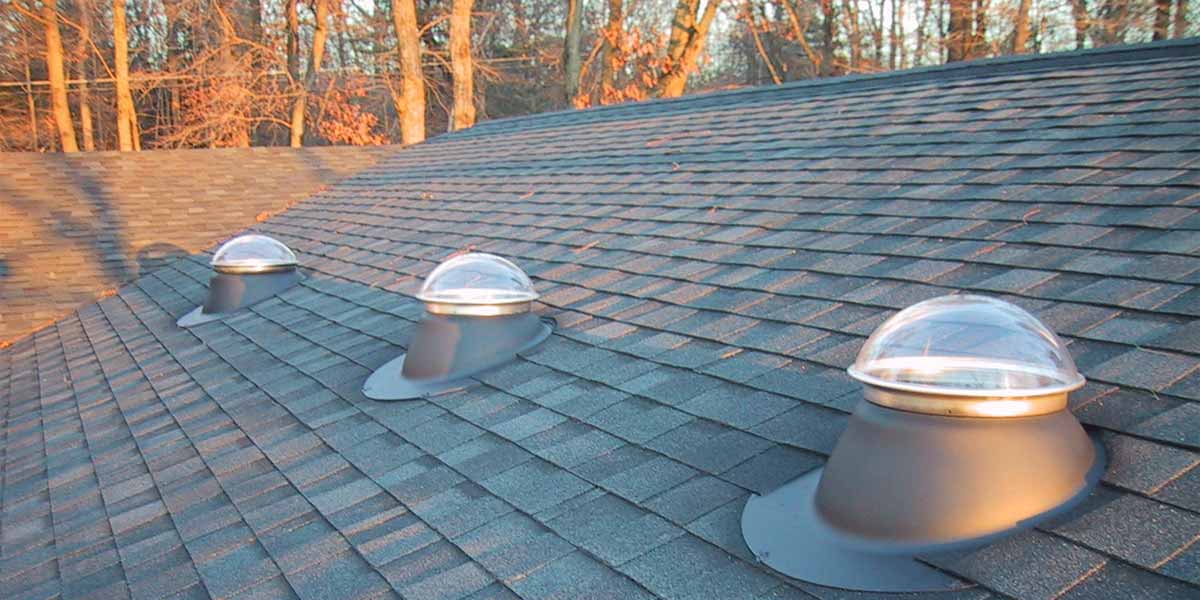
A solar tube is a daylight pipe. It does not generate electricity, it has no solar panel, no battery and no LED, and it delivers exactly nothing after sunset. If you arrived here expecting a solar product, the distinction matters — this is daylighting, closer to a skylight than to anything in the photovoltaic or solar thermal families.
Tubular daylighting devices (TDDs) are genuinely good at one job: lighting an interior room that has no exterior wall. The case against them is not that they fail. It is that the numbers they are sold on are optimistic, and the drawbacks are quantifiable. Here they are.
1. There is no answer to night, or to a dark day
This is the limit the product category cannot engineer around. A TDD’s output tracks outdoor illuminance, and outdoor illuminance falls by a factor of ten under overcast sky and to zero after dusk.
Manufacturers do not publish delivered lumens, so here is the arithmetic. A 10-inch tube has an aperture of 0.055 m²; a 14-inch tube, 0.099 m². Solatube’s NFRC-certified annual visible transmittance for its 160 DS and 290 DS is 0.42. Multiply through:
| Sky condition | Outdoor horizontal light | 10 in. tube | 14 in. tube |
|---|---|---|---|
| Clear, summer noon | ~100,000 lux | ~2,100 lumens | ~4,200 lumens |
| Clear, winter noon at 40°N | ~40,000 lux | ~850 lumens | ~1,700 lumens |
| Overcast | ~10,000 lux | ~210 lumens | ~420 lumens |
| After sunset | 0 | 0 | 0 |
That is our calculation, not a measurement, and the winter row is generous because VT-annual is a yearly average that low sun angles drag below. But it puts the widely repeated “a 10-inch solar tube equals three 100-watt bulbs” in context. Three 100-watt incandescents are about 4,800 lumens. A 10-inch tube gets near that only at the top of a clear summer day, and a 14-inch tube is the one that actually hits it. On a gray February afternoon the same 10-inch tube is delivering roughly what a 3-watt LED night light produces.
Both brands sell an electric light kit that mounts inside the tube for exactly this reason. Budget for it, or keep the existing fixture. If you are lighting a space where the switch goes on at night anyway, an indoor solar light or a plain efficient fixture is doing most of the work regardless.
2. Light output falls off with length, bends and sun angle
Light travels a TDD by bouncing, roughly once per foot of tube. Every bounce costs whatever the liner absorbs, so losses compound. Solatube publishes the comparison, and it is arithmetically just reflectivity raised to the number of bounces:
| Tubing material | Specular reflectivity | 10 ft run | 20 ft | 30 ft | 40 ft |
|---|---|---|---|---|---|
| Solatube Spectralight Infinity | 99.7% | 97% | 94% | 92% | 89% |
| Enhanced silver | 97% | 74% | 54% | 41% | 31% |
| Enhanced aluminum | 95% | 60% | 36% | 23% | 14% |
| Corrugated / flexible | 84% | 18% | 3% | 1% | 0.1% |
Read that bottom row carefully. It comes from a rigid-tube manufacturer, so treat it as advocacy, but the physics is not in dispute and it explains why VELUX caps a flexible Sun Tunnel at 8 ft for the 14-inch model and 12 ft for the 22-inch, against 25 ft for the rigid version, and tells you in its own product guide that it “recommends the Rigid Model for maximum light output.” If your attic run is longer than a couple of feet, flexible tubing is the wrong choice and the difference is not marginal.
Sun angle matters more than either. A 2023 simulation study in Sustainability modeled a generic light pipe at three sun angles and three lengths:
| Pipe length | Sun straight down the tube | 45° off axis | 15° off axis (low sun) |
|---|---|---|---|
| 500 mm (20 in.) | 47.3% | 18.3% | 5.9% |
| 700 mm (28 in.) | 47.2% | 17.6% | 5.5% |
| 2,000 mm (6.5 ft) | 44.7% | 11.4% | 3.2% |
Tripling the length cost a few points. Dropping the sun to a winter angle cost about 85 percent. That is the honest reason a solar tube underwhelms in January, and it is why roof orientation and dome optics get so much attention in the marketing.
Bends are the third axis and the least documented. Neither Solatube nor VELUX publishes a per-elbow loss figure; they publish the maximum bend they will warrant, which is 90 degrees for Solatube and 45 degrees per rigid elbow for VELUX. Assume every elbow costs you real light and plan a straight drop if you can.
3. “99 percent reflective” is the mirror, not the system
The 99-percent figure repeated across this topic describes the tube liner’s specular reflectance per bounce. It is not how much daylight reaches your room. NFRC 203 rates whole TDDs at 18 solar positions and reports an annual average. Solatube’s own certified summary lists VT-annual of 0.42 to 0.53 for the 160 DS and 290 DS, and 0.40 to 0.75 across its commercial line. Roughly half the daylight hitting the dome arrives downstairs, and even that figure is a clear-sky average for a 9-to-5 day at 40 degrees latitude.
4. Diameter sets the room size, and the small one is genuinely small
Solatube rates the 10-inch 160 DS for 150–200 sq ft and the 14-inch 290 DS for 250–300 sq ft, with maximum tube runs of 20 ft and 30 ft respectively. Independent testing supports the size gap. Lawrence Berkeley National Laboratory tested ten TDD configurations from both brands in a windowless 16 × 14 ft test cell and measured potential lighting energy savings of 27–69 percent for 22-inch units and only 22–32 percent for 14-inch units. Same room, same sky, less than half the benefit.
LBNL found something else worth knowing before a salesperson upsells you: at a given diameter there were no substantial differences in daylight delivery or visual comfort between clear and prismatic domes, or between prismatic, Fresnel and frosted diffusers. Buy diameter. The optics packages are largely a wash.
5. It is a hole in your insulation and your air barrier
A TDD is a thermal weak point, and per square foot it is not better than a skylight. Solatube’s NFRC data gives the 160 DS and 290 DS a U-factor of 0.52 (R-1.9) and an SHGC of 0.20–0.32. A decent double-pane low-e skylight lands in the same range. The advantage is area, not efficiency: a 14-inch tube is 1.07 sq ft against roughly 8 sq ft for a 2×4 skylight. The attic floor around it is typically R-49, so the tube is about 25 times leakier per square foot than the ceiling it replaced.
Cold climates add condensation. Solatube’s specification describes a tube ring whose job is “to prevent thermal bridging between base flashing and tubing and channel condensed moisture out of tubing,” which is the manufacturer confirming that moisture forms inside the tube. Both brands sell add-ons for it — Solatube’s Thermal Insulation Panel improves U-factor from 0.52 to 0.39, VELUX sells an Energy Kit cap. Neither comes standard.
And the warranty is explicit: VELUX states that condensation “is not a ‘leak,’ is not covered by this warranty and is specifically excluded.” If you live somewhere with real winters, price the thermal kit into the job from the start.
6. Heat and UV through the dome, and yellowing over time
The dome does block UV well. Solatube’s spec sheet states the acrylic outer dome is UV-inhibiting at 100 percent UV-C, 100 percent UV-B and 98.5 percent UV-A. That is good for your rugs and it also kills a claim repeated on several competing pages: with 100 percent of UV-B stopped, a solar tube cannot produce vitamin D. It admits visible light and near-infrared, which is what the solar heat gain coefficient of 0.20–0.32 measures.
Yellowing is real and the manufacturers put numbers on it. VELUX warrants a clear acrylic Sun Tunnel dome to a yellowness index below 4.0 for five years and below 10.0 for ten years (ASTM D 1925). A polycarbonate dome gets the five-year clause only, with no ten-year figure — polycarbonate yellows faster, and the warranty structure says so. The rigid tunnel liner carries a 20-year warranty against yellowing and darkening; the flexible tunnel carries no equivalent. Expect a visible warm shift in the light over a decade, the same way outdoor plastic lenses yellow.
Color shift has a second cause. Solatube’s technical FAQ notes that liners which are not spectrally neutral reflect some wavelengths better than others, so the delivered light drifts green-blue or yellow with each bounce. Cheap aluminum tubing shifts color; premium tubing mostly does not.
7. Leaks, pests and roof limits
“Solar tubes don’t leak” is the most common false claim in this category, and our own earlier version of this page made it. They leak where every roof penetration leaks: at the flashing. VELUX backs a 10-year No Leak installation warranty, and caps reinstallation reimbursement at $1,000 — a cap exists because claims exist. Insects get in the same way, through gaps between the flashing base, tube ring and dome seal rather than through the tube itself, which is why a sloppy install shows up as debris on the diffuser within a year.
Roof type also rules homes out. VELUX’s code report covers slopes up to 60 degrees, with the common pitched and low-profile flashings designed for 3:12 and above. Flat roofs need a curb-mounted unit; tile needs a separate flashing kit. Check your roof type and pitch before you get attached to the idea.
8. The payback argument does not survive contact with a calculator
This is where the category oversells hardest. A Solatube-authorized installer publishes installed pricing of $1,200–$1,350 for a 10-inch unit and $1,300–$1,450 for a 14-inch, based on up to 8 ft of tubing. Solatube’s own blog quotes $900–$1,200. The $500–$750 figures across this SERP are years out of date. Our solar tube installation cost guide breaks the line items down.
Now the saving. EIA’s most recent RECS found lighting is about 6 percent of household electricity, 81 billion kWh nationally, which works out to roughly 650 kWh per home per year. At the 2025 US average residential rate of 17.3 cents, that is about $113 a year for every light in the house. A TDD serves one room, during daylight hours only. A bathroom with three 9-watt LED bulbs running two hours a day costs $3.41 a year to light. A hallway on 20 watts for four hours costs $5.05.
Even if a solar tube eliminated that room’s lighting bill entirely, which it cannot because half the usage is after dark, simple payback on a $1,350 installation runs past two centuries. The thermal penalty is equally trivial in dollars. Buy a solar tube because the room is nicer to be in. Do not buy it as an energy investment.
Where a solar tube is the right answer
An interior bathroom, a windowless hallway, a stairwell, a walk-in closet, a laundry room. Anywhere with no exterior wall, a short straight attic run above it, and a roof you are not about to replace. In those spaces nothing else competes: a skylight needs a framed light shaft, a window is impossible, and the alternative is a bulb burning all day. LBNL measured no glare problems across all ten configurations it tested, with peak daylight glare probability of 0.33 against a 0.35 threshold. The product works.
When something else wins
| Situation | Better choice | Why |
|---|---|---|
| Room has any exterior wall | A window | More light, a view, ventilation, and low-e glazing controls the heat |
| You want the view or the sky | Conventional skylight | A tube shows you a lit disc and nothing else |
| Vaulted or cathedral ceiling | Conventional skylight | No attic run to pipe through; a tube gains you nothing |
| You need venting or shades | Vented skylight | TDDs cannot be opened or shaded in any meaningful way |
| Cold climate, long attic run, many bends | Efficient LED fixture | Transmission and condensation risk both work against you |
| Shed, garage, detached structure | Solar shed light or a solar wall light | A fraction of the cost, and it works at night |
| Purely to cut the power bill | Nothing; keep your money | See the payback math above |
The fair summary: solar tubes are a good architectural fix for a specific problem and a poor energy investment sold as a good one. Match them to the room, buy the largest diameter that fits, insist on rigid tubing, and ignore the payback pitch entirely.
Sources
- Lawrence Berkeley National Laboratory - Zero Net Energy Retrofits for Small Commercial Offices: TDD FLEXLAB Test Results escholarship.org Measured lighting energy savings of 27-69% for 22-inch units against 22-32% for 14-inch; no substantial performance difference between dome or diffuser types at a given diameter; peak daylight glare probability of 0.33 against a 0.35 threshold
- Solatube International - Light Output of Various Tubing Materials solatube.com Specular reflectivity and surviving light output by tubing material at 10, 20, 30 and 40 ft, and roughly one bounce per foot at a 40-degree solar altitude
- Solatube International - Visible Transmittance Summary (NFRC 203-2020) solatube.com Certified VT-annual of 0.42-0.53 for the 160 DS and 290 DS, and the test-method note confirming a clear-sky, 9am-5pm, 40-degree-latitude basis
- Solatube International - Daylighting System Thermal Performance Characteristics solatube.com NFRC U-factor of 0.52 (R-1.92) and SHGC of 0.20-0.32, improving to U-0.39 only with the extra-cost Thermal Insulation Panel
- VELUX - Limited Warranty (XUS 20194-0526) veluxusa.com Acrylic dome yellowness index under 4.0 at five years and under 10.0 at ten per ASTM D 1925, with polycarbonate getting the five-year clause only; the 20-year rigid liner warranty; condensation explicitly excluded from the leak warranty; the $1,000 reinstallation cap
- VELUX - Sun Tunnel Skylight Guide f.hubspotusercontent00.net A 25 ft maximum rigid run against 8 ft flexible for the 14-inch and 12 ft for the 22-inch, the company's own recommendation of the rigid model for maximum light output, and 45-degree adjustable elbows
- Song, Dessie & Gao - Sustainability 15(14) 11044, 2023 mdpi.com Simulated light pipe transmission efficiency by sun incidence angle and pipe length, showing that dropping the sun to a winter angle costs far more than tripling the tube length
- US Energy Information Administration - How much electricity is used for lighting in the United States? eia.gov That residential lighting is about 6% of home electricity use and 81 billion kWh nationally, the basis for the roughly $113-a-year whole-house lighting figure
Questions people ask
What are the downsides of solar tubes?
Eight, in order of how much they matter: no light at night, output collapsing under overcast and low winter sun, losses that compound with tube length and bends, a small diameter lighting a genuinely small area, a U-0.52 penetration through your insulation, condensation that warranties exclude, dome yellowing over a decade, and installed costs of $1,200 to $1,450 that no lighting saving will ever repay.
Are solar tubes worth the money?
Worth it if the room has no exterior wall and you want daylight in it. Not worth it as an energy investment. A US home spends roughly $113 a year on all its lighting, so a single tube serving one room saves a few dollars annually against $1,200 to $1,450 installed. Simple payback runs into the centuries. Buy it for the daylight, not the bill.
How long do solar tubes typically last?
The structure outlasts the optics. VELUX warrants a Sun Tunnel unit for 10 years and its rigid tunnel liner for 20 years against yellowing, darkening and peeling. The acrylic dome is warranted to a yellowness index below 4.0 for five years and below 10.0 for ten. Polycarbonate domes get the five-year clause only. Expect a visible warm shift in the light after a decade.
Do solar tubes leak less than skylights?
Probably, but they do not leak less than zero, and 'no leak' claims are marketing. A solar tube is a roof penetration and it leaks where every penetration leaks: the flashing. VELUX offers a 10-year No Leak installation warranty with reinstallation reimbursement capped at $1,000. The smaller dome does shed debris better than a flat skylight, which is the real advantage.
Which is better, Solatube or VELUX?
Lawrence Berkeley National Laboratory tested 22-inch units from both brands head to head and found no substantial difference in daylight delivery or visual comfort at a given tube diameter. Choose on diameter, on rigid versus flexible tubing, and on which brand has a competent installer near you. Diameter is the variable that actually changes how much light reaches the room.
Do sun tunnels really brighten a room?
Yes, in daylight, in a room the right size. Manufacturer coverage ratings are 150 to 200 sq ft for a 10-inch tube and 250 to 300 sq ft for a 14-inch. LBNL measured potential lighting energy savings of 27 to 69 percent for 22-inch units and 22 to 32 percent for 14-inch units in a windowless 224 sq ft test room. Larger diameter, more light.
What is the average cost of a solar tube?
Roughly $1,200 to $1,450 installed in 2026. A Solatube-authorized installer publishes $1,200 to $1,350 for a 10-inch unit and $1,300 to $1,450 for a 14-inch, based on up to 8 feet of tubing. Solatube's own blog quotes $900 to $1,200. DIY kits start near $400. The $500 to $750 figures still circulating online are years out of date.