If you are picking between polycrystalline and monocrystalline panels for a roof in 2026, there is no longer a decision to make. Polycrystalline modules were about 70% of world production in 2016. In 2025, production was zero. Fraunhofer ISE, which has tracked this annually for two decades, now states it flatly: “In practice, multi-crystalline silicon technology has disappeared from the market.”
That is not a prediction or a trend line. It is the current edition of the industry’s standard reference. Almost every page still arguing this comparison is re-running a 2015 trade-off for a reader who cannot act on it.
So this article does two things. It explains what genuinely separated the two technologies, with real numbers instead of the recycled ranges you will find elsewhere. And it tells you what to compare instead, because the specs that actually distinguish one modern panel from another have nothing to do with how the silicon was crystallised.
The comparison ended, and we can date it
Fraunhofer ISE publishes its Photovoltaics Report every July, with the same methodology and the same underlying ITRPV data year after year. Reading two editions nine years apart is the clearest possible answer to “which should I buy.”
| Report of 12 July 2017 (2016 data) | Report of 14 July 2026 (2025 data) | |
|---|---|---|
| Multicrystalline share of production | about 70% | 0 GWp of 706 GWp |
| Silicon wafer share of all PV | about 94% | about 98% |
| Dominant cell technology | aluminium back-surface-field, p-type | monocrystalline n-type TOPCon (86% n-type wafers) |
| Record lab cell, single-crystal silicon | 26.7% | 28.1% |
| Record lab cell, multicrystalline silicon | 21.9% | no longer listed |
That last row deserves a moment. The multicrystalline record was 21.9% in mid-2017, Fraunhofer ISE pushed it to 22.3% that September, and it has essentially sat there ever since because nobody is funding the research any more. The 2026 report gives explicit record figures for single-crystal silicon, perovskite, perovskite-silicon tandems, CIGS and CdTe. Multicrystalline silicon is simply absent.
Commercial modules tell the same story from the other end. Across the top ten manufacturers, the shipment-weighted average efficiency of crystalline silicon modules was 22.7% in Q4 2024, with the range running 18.9% to 24.8%. A decade ago the commercial average was about 17%.
Why polycrystalline lost, and it was not mainly efficiency
The efficiency gap between mono and poly was never as large as the marketing suggested. What killed poly was that the industry’s next upgrade did not work on it.
Around 2015, manufacturers began replacing the old aluminium back-surface-field cell with PERC, which adds a passivating layer at the rear of the cell. PVEducation, the UNSW reference text, puts the consequence plainly: “The PERC structure enables higher efficiencies for monocrystalline cells, but does not give much performance boost for multicrystalline cells.” Every producer faced the same arithmetic. Upgrade a mono line and you gained roughly a percentage point of efficiency. Upgrade a multi line and you gained very little. The capital went one way.
Two other things happened at once. Diamond wire sawing cut silicon consumption hard, from about 16 g per watt in 2004 to roughly 2.0 g/Wp by 2024 on 140-micron wafers, which erased most of poly’s raw-material cost advantage. And the architectures that replaced PERC, n-type TOPCon and heterojunction, are built on mono wafers in commercial practice. By 2025, 86% of wafers were n-type.
PVEducation dates the consumer-facing result precisely: “starting in 2018, monocrystalline silicon began to dominate and by 2020 and 2021 it became difficult to buy multicrystalline silicon cells.” It also notes something none of the comparison pages mention, which is that “cast-mono” wafers have blurred the boundary between the two categories anyway. This is one of several cost collapses in solar that were driven by manufacturing rather than by any breakthrough in the cell itself.
What grain boundaries actually do
The physical difference is real, and it is about recombination rather than resistance, which is where most articles get it wrong.
Multicrystalline silicon is cast, so it solidifies as many separate crystal grains rather than one continuous lattice. At the boundary between grains the atomic bonds are strained and broken. Those broken bonds create defect energy levels near the middle of the band gap, and mid-gap states are extremely effective at capturing charge carriers. As PVEducation describes it, grain boundaries “introduce high localized regions of recombination… thus reducing the overall minority carrier lifetime from the material,” and they also “reduce solar cell performance by blocking carrier flows and providing shunting paths for current flow across the p-n junction.”
A light-generated electron that recombines before it reaches a contact contributes nothing. Practically, this is why grain size matters: grains need to be “on the order of at least a few millimeters” so a single grain can span the full thickness of the cell. For comparison, the carrier diffusion length in single-crystal silicon is typically 100 to 300 microns.
A terminology note, since it appears nowhere else. In materials science, “polycrystalline” silicon means grains between 1 micron and 1 millimetre. Solar panels sold as “polycrystalline” actually use multicrystalline silicon, with grains from 1 mm to 10 cm. The retail name has been wrong for thirty years. Everyone understands what it means, so the error is harmless, but it is worth knowing if you read a datasheet that says “multi.” If you want the underlying device physics, start with how a solar cell differs from a photodiode and what fill factor measures.
Why poly is blue and speckled, and mono is black
Neither colour comes from the silicon. Both come from the anti-reflective coating, and the speckle comes from the grains.
Bare silicon reflects more than 30% of the light hitting it, so every cell gets a quarter-wave anti-reflective coating of silicon nitride, tuned to cancel reflection near 0.6 microns because that is close to the peak of the solar power spectrum. Suppress reflection hardest in the orange-green and what bounces back is weighted toward blue. PVEducation demonstrates this with a photograph of four multicrystalline wafers in four different colours, captioned: “The difference in color is solely due to the thickness of the film.” Same silicon, same grains, different colour. Colour is a process setting.
The mosaic pattern is different and is genuinely diagnostic. Single-crystal wafers are cut on the <100> plane, which lets an alkaline etch carve a dense field of microscopic pyramids that bounce light back into the cell instead of out of it. That does not work on multicrystalline wafers, because, as PVEducation puts it, “only a small fraction of the surface will have the required orientation of <100>.” Multi wafers get an acid etch instead, which “gives a more uniform etch rate across grain boundaries” but traps less light. Each grain then takes the etch slightly differently and reflects at its own angle, so “grains of different orientation show up as light and dark.” That is the speckle.
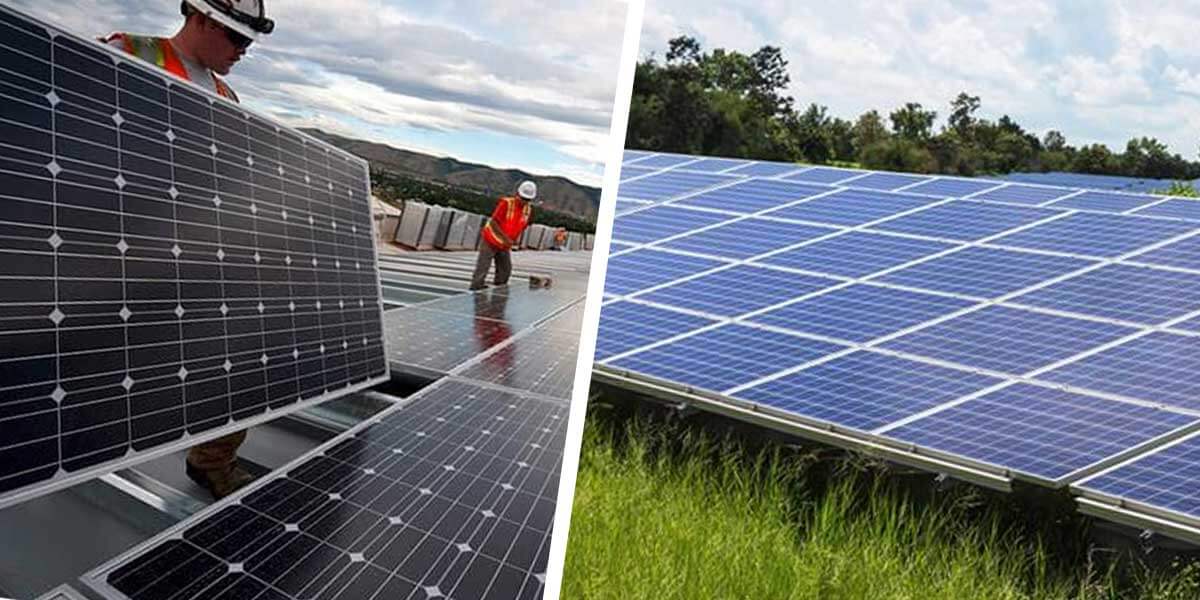
The practical test, if you are looking at an old array: multicrystalline cells are perfect squares with a visible mosaic. Traditional mono cells are cut from a round ingot, so they have chamfered corners and a small gap at each cell corner, and they are uniform. Modern large-format mono wafers are often full squares too, so corner shape alone is no longer conclusive. The mosaic is.
The temperature coefficient myth, in one manufacturer’s own numbers
Every page on this topic claims monocrystalline handles heat better. Here is a like-for-like comparison from a single manufacturer, two modules from the same 60-cell platform, identical 1650 x 992 x 40 mm frames, taken from the datasheets.
| Spec | Canadian Solar CS6K-P (poly) | Canadian Solar CS6K-M-SD (mono) | Canadian Solar CS6.2-48TD (n-type TOPCon) |
|---|---|---|---|
| Temp. coefficient, Pmax | −0.41 %/°C | −0.41 %/°C | −0.29 %/°C |
| Temp. coefficient, Voc | −0.31 %/°C | −0.31 %/°C | −0.25 %/°C |
| Temp. coefficient, Isc | +0.053 %/°C | +0.053 %/°C | +0.05 %/°C |
| Nominal operating cell temp. | 45 ± 2 °C | 45 ± 2 °C | — |
| Module efficiency | 15.88–16.80% | 16.50–17.11% | 21.8–23.0% |
Every temperature figure is identical between the mono and the poly module. Not similar. Identical. The mono panel’s only advantage on that platform was that the product line extended one power step higher; at a matched 270 W, both modules were 16.50% efficient.
The real improvement, from −0.41 to −0.29 %/°C, came from switching to n-type TOPCon, which is a doping and cell-architecture change that has nothing to do with mono versus poly. Jinko’s Tiger Neo and Trina’s Vertex N independently publish the same −0.29 %/°C. Over a 40°F swing above test conditions that difference is worth roughly 2.7% of output, which is a real number, and it is a reason to prefer n-type over p-type. It is not a reason to prefer mono over poly.
Also note what several top-ranking pages print: a polycrystalline temperature coefficient “up to −1 %/°C.” No crystalline silicon module has ever had that. It appears to be a figure copied between blogs until it became furniture. If you live somewhere genuinely hot, the temperature coefficient is the spec to read, and it is the same on both technologies. Whether the economics work at all in a hot, humid state is a separate question, covered in are solar panels worth it in Florida.
Low light: the claim runs backwards
Mono is widely said to perform better in cloud and shade. The manufacturer’s own paperwork says otherwise.
The Canadian Solar poly datasheet advertises “outstanding performance at low irradiance, with an average relative efficiency of 96.5% from irradiances between 1000 W/m² and 200 W/m².” The matching mono datasheet makes no low-irradiance claim at all. Whatever else is true, the company selling both did not think mono was the low-light product.
The physics agrees that the crystal structure is not the driver. At low light, output is dominated by shunt resistance, because there is less light-generated current to compare the leakage against. PVEducation: “under cloudy conditions, a solar cell with a high shunt resistance retains a greater fraction of its original efficiency than a solar cell with a low shunt resistance.” Shunt resistance is a manufacturing-quality and cell-design parameter, not a property of mono or multi wafers. There appears to be no controlled IEC 61853 comparison of mono against poly modules at low irradiance in either direction, so the honest position is that the popular claim is unsupported rather than disproved. If you are worried about grey-sky output, read how panels behave in winter and what actually drives panel efficiency in the field, which is mostly temperature, soiling, shading and angle.
Degradation and warranty, where sources genuinely disagree
The long-running reference is the degradation work from the US national laboratory in Golden, Colorado, known as NREL until its recent renaming to the National Laboratory of the Rockies. Its 2013 analytical review of nearly 2,000 measured degradation rates found a median of 0.5% per year, and the larger 2016 compendium put crystalline silicon at 0.5–0.6% per year against roughly 1% for thin film. Neither identifies crystal structure as a major variable; climate, mounting and manufacturing vintage matter far more.
A 2025 compendium in Solar Energy Materials and Solar Cells reaches a notably worse figure: a global median of 1.00% per year and a mean of 1.27%, described as an increase over the 2013 and 2016 studies. That is a real disagreement in the literature, not a rounding difference, and anyone telling you confidently that panels lose “0.5% a year, full stop” is quoting one side of it. Plan with the range, not the optimistic end. Our longer treatment is in how long solar panels last.
Warranties moved in the meantime. A 2016-era poly module typically carried a 10-year product warranty and a 25-year linear performance warranty. A current n-type module such as the CS6.2-48TD carries 15 years on product and 30 years of linear performance, with first-year degradation capped at 1% and every subsequent year at 0.4%. That is the single biggest practical difference between a 2016 panel and a 2026 one, and it is worth more than any efficiency figure.
Where polycrystalline still genuinely shows up
Poly is gone from rooftops, not from the world. Check the big residential channels and you will find monocrystalline only: Renogy, Signature Solar and the EnergySage marketplace list no polycrystalline modules at all.
Small panels are a different market. Polycrystalline is still routine in the 5 W to 50 W industrial and off-grid segment, where efficiency per square inch barely matters and the panel is powering a gate opener, a livestock gate, a telemetry box or a trickle charger. Solartech, Victron, Aleko and similar brands still list explicitly polycrystalline 20 W and 30 W 12-volt modules at US retail, typically $25 to $95. A word of warning on labelling in this segment: the same Coleman 100 W panel is sold as “Polycrystalline” by one big-box retailer and simply “crystalline” by two others, so the sticker is not always reliable.
Garden and pathway lights split by price. Budget multi-packs frequently use small polycrystalline cells, and you will see “polycrystalline silicon solar panel” in the spec text of plenty of current listings. Premium fixtures have mostly moved to mono. Smaller still, the cells in calculators and solar keyboards are usually amorphous silicon, which is not crystalline at all and performs comparatively well under weak indoor light. If you are judging a garden light, the cell type matters far less than the panel’s physical size and how filthy it gets, which is why cleaning the panel and giving it genuine direct sun do more for runtime than any cell technology. Our own solar pathway lights ship from Garden Grove, California, and if you are trying to get more out of what you already own, start with making solar garden lights brighter.
What to compare instead
Four specs separate one modern panel from another. None of them is the crystal.
- Module efficiency. Not cell efficiency, which is always higher and is not what you install. Current modules run 18.9% to 24.8%. This determines how many watts fit on your roof, so it matters most when space is tight. The method is in calculating solar panel efficiency, and physical footprint is covered in panel dimensions and weight.
- Temperature coefficient of Pmax. Around −0.29 %/°C for n-type, around −0.35 %/°C for mono PERC. Panels run far hotter than the 77°F test condition, so in Arizona or Texas this is worth more than a fraction of a point of rated efficiency.
- Degradation rate and warranty length. Read the first-year figure and the annual figure separately, and check the product warranty as well as the performance warranty. They are different terms and the product warranty is usually the shorter one.
- Who honours the warranty. A 30-year warranty is worth what the company behind it is worth in year 25. Several brands named as market leaders in older versions of this very article no longer make panels. US-made options and the cautionary reading in avoiding solar scams are both relevant here.
Several things people worry about do not depend on cell type at all, and you can stop factoring them into this decision: hail resistance is a glass and certification question, covered in protecting panels from hail; lightning risk is a grounding question and the answer is in do solar panels attract lightning; and the failure modes in common solar panel problems and repairing a broken panel are identical across both technologies. Sizing is also independent of cell type, so panels needed for 1,000 kWh a month, cost for a 1,500 square foot house and optimum tilt angle all apply either way. And if what you actually want is daylight in a dark hallway rather than electricity, that is a different product with different economics, covered in the cost of solar tube installation.
If a 2026 quote lists polycrystalline panels
Ask where the modules came from and check the manufacturing date on the label. Nothing polycrystalline has been produced at scale for years, so a poly module in a new residential quote is old warehouse stock, and its warranty clock may have started at manufacture rather than at installation. That is not automatically a bad deal if the price reflects it, but it should be priced as surplus inventory and not as a current product. Before signing anything, test what you are given: how to test solar panels covers verifying a module actually delivers its rating. For a sense of how quickly brand names age in this industry, our older LG versus SunPower comparison is instructive, and for the small stuff, portable panels are now effectively all mono too.
Sources
- Fraunhofer ISE - Photovoltaics Report, updated 14 July 2026 ise.fraunhofer.de 2025 production of 0 GWp multi-Si against 690 GWp mono-Si of 706 total; that multicrystalline technology has disappeared from the market; 98% wafer silicon and 86% n-type; the 28.1% record mono cell; commercial module efficiency of 22.7% weighted average across an 18.9-24.8% range; silicon use falling from 16 g/Wp in 2004 to 2.0 g/Wp in 2024
- Fraunhofer ISE - Photovoltaics Report, updated 12 July 2017 irena.org That multicrystalline was about 70% of total production in 2016, 94% wafer silicon, and record cells of 26.7% mono against 21.9% multi - the other end of the nine-year comparison
- PVEducation (Honsberg & Bowden, UNSW) - Multicrystalline silicon pveducation.org The grain-boundary recombination mechanism and reduced minority carrier lifetime; the millimetre grain-size requirement; that PERC benefits mono but not multi; that mono dominated from 2018 and multi cells became hard to buy by 2020-21; cast-mono blurring the categories
- PVEducation (UNSW) - Surface texturing and anti-reflection coatings pveducation.org The orientation requirement for pyramid texturing and why it fails on multi wafers; acid texturing giving a uniform etch across grain boundaries; the coating tuned to 0.6 microns; and that colour is set solely by nitride film thickness
- Canadian Solar CS6K-P datasheet (polycrystalline, 260-275 W) natec.com Pmax -0.41 %/C, Voc -0.31 %/C, Isc +0.053 %/C, NOCT 45+/-2 C, efficiency 15.88-16.80%, and the low-irradiance claim of 96.5% average relative efficiency between 1000 and 200 W/m2
- Canadian Solar CS6K-M-SD datasheet (monocrystalline, 270-280 W) invertersupply.com Temperature figures identical to the poly module on the same platform, and no low-irradiance claim anywhere in it
- Canadian Solar TOPHiKu6 CS6.2-48TD datasheet (n-type TOPCon, 435-460 W) static.csisolar.com Pmax -0.29 %/C and Voc -0.25 %/C, 21.8-23.0% efficiency, and the 15-year product and 30-year linear performance warranty with first-year degradation capped at 1%
- Jordan & Kurtz - Photovoltaic Degradation Rates, an Analytical Review (Progress in Photovoltaics, 2013) doi.org The median 0.5% per year across nearly 2,000 measured degradation rates, with no major mono/multi split identified
- Jordan et al. - Compendium of photovoltaic degradation rates (Progress in Photovoltaics, 2016) doi.org Crystalline silicon at 0.5-0.6% per year against roughly 1% for thin film
- Chen, Zuo & Chang - Compendium of degradation rates of global photovoltaic technology (Solar Energy Materials and Solar Cells, 2025) doi.org A global median degradation of 1.00% per year and mean of 1.27%, explicitly an increase over the 2013 and 2016 compendia - the disagreement this article refuses to paper over
Questions people ask
Which is better, monocrystalline or polycrystalline solar panels?
Monocrystalline, but the question no longer has a practical answer. Polycrystalline modules made up about 70% of world production in 2016 and zero in 2025, so a US buyer cannot order a new poly rooftop panel. Every panel you can actually buy for a roof is monocrystalline. The real choice now is between p-type PERC and n-type TOPCon, which differ in temperature coefficient and warranty length.
Are polycrystalline solar panels still made?
Not at rooftop scale. Fraunhofer ISE's 2026 report records 0 GWp of multicrystalline production against 690 GWp of monocrystalline in 2025 and states the technology has disappeared from the market. Polycrystalline cells are still produced for small applications: 5 W to 50 W off-grid panels for gate openers and trickle chargers, and budget garden lights. Those are a different supply chain from residential modules.
How can you tell if a solar panel is polycrystalline or monocrystalline?
Look for the mosaic. Polycrystalline cells show a visible patchwork of lighter and darker facets because each crystal grain reflects at a different angle. Monocrystalline cells are uniform. Do not rely on colour, since blue versus black comes from anti-reflective coating thickness and can be tuned either way. Traditional mono cells also have chamfered corners from the round ingot, though modern large-format wafers are often full squares.
What are the disadvantages of monocrystalline panels?
Higher cost per watt than poly was, and a more energy-intensive ingot process. Both objections have largely dissolved: diamond wire sawing cut silicon use from roughly 16 grams per watt in 2004 to about 2.0 g/Wp by 2024, and poly is no longer available to compare against. The genuine remaining drawbacks are shared by all crystalline silicon: output falls as the panel heats, and shading one cell affects its whole string.
What is the 20% rule for solar panels?
It is not a rule. No electrical code, standard or federal program defines a 20% rule, and the pages promoting it contradict each other: some say size the array 20% above your usage, others say cover only 80% of it. Those are opposite instructions. The real code provision people half-remember is the NEC busbar limit on backfed breakers. Size your system from your actual annual kWh and your roof, not a slogan.
Do polycrystalline panels last as long as monocrystalline?
Broadly yes. The long-running degradation studies put crystalline silicon at a median 0.5 to 0.6% per year and do not identify crystal structure as a significant variable; climate, mounting and manufacturing quality matter far more. A 2025 compendium reports a worse global median of 1.00% per year, so the literature genuinely disagrees. Plan with a range, not a single number.
Is there still a price difference between monocrystalline and polycrystalline?
Not one you can use. Poly's cost advantage came from cheaper wafers and simpler casting, and both advantages disappeared as mono production scaled and silicon consumption fell. Where poly still sells, in 20 W to 30 W off-grid panels at roughly $25 to $95, it is priced against mono rather than below it. Any residential quote listing poly in 2026 is moving old inventory.