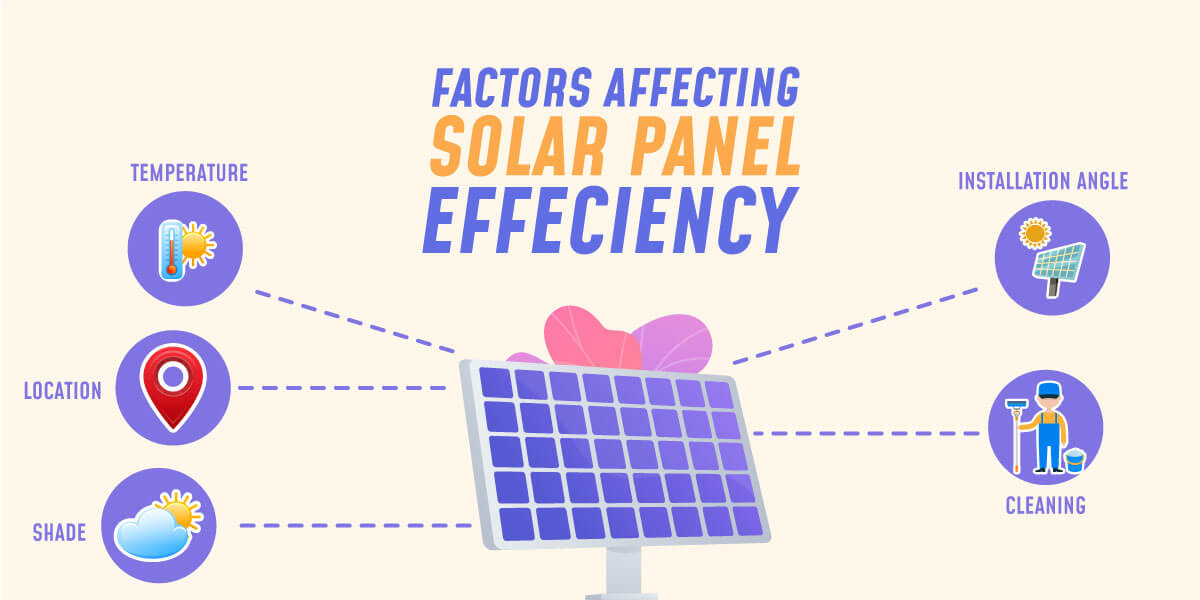
Five things dominate what a solar array gives you and they are nowhere near equal. Temperature is the largest by a wide margin and the one nobody puts a number on. Below is the ranking in percent with a source on every line, plus a warning: the order changes with where you live and how the panels are bolted down.
Module efficiency and performance ratio are two different numbers
Conflating these two is the mistake underneath most of the confusion on this topic. Module efficiency is a fixed nameplate property: how many watts fit in a square meter. Canadian Solar’s CS6.2-48TD is 455 W in a panel measuring 69.4 by 44.6 inches, which is almost exactly 2 square meters. Full sun delivers 1,000 watts per square meter, so 2,000 watts land on it and 455 come out. That is 22.8%, and it is printed on the datasheet.
Nothing you do to the array changes that number. Washing it does not. Tilting it does not. Buying a “more efficient” panel only means you need less roof for the same kilowatts, which matters if your roof is small and is close to irrelevant if it isn’t. Our panel efficiency calculation guide walks the arithmetic, and the panel size guide covers why 2 square meters is now the standard footprint.
Performance ratio is the other number: what you actually harvested divided by what the nameplate says you should have harvested from the sunlight that hit the plane of the array. Everything below moves performance ratio. Almost nothing below moves module efficiency. When an article says shade “reduces panel efficiency,” it means performance ratio, and the sloppiness hides how large the losses are.
The ranking, in percent
These are annual energy losses for a grid-tied residential rooftop system in the lower 48, largest first.
| Factor | Typical annual cost | Bad case | Source |
|---|---|---|---|
| Cell temperature | 6–10% | 13–15% (desert roof, older module) | Computed from datasheet coefficients + Sandia thermal model |
| Shading | 3% | 10–30%+ with a tree or a chimney | PVWatts v5 default, from installed-system surveys |
| Inverter conversion | 3–4% | — | PVWatts default 96%; Enphase IQ8 is 97.0% CEC-weighted |
| Availability (downtime) | 3% | — | PVWatts v5 default |
| Wiring and connections | 2.5% | — | PVWatts v5 default |
| Reflection at angle | 2–3% | — | PVWatts module-cover transmission model |
| Soiling | 2% | 7.4% across a 145-day California drought | Mejia & Kleissl, 186 California systems |
| Mismatch between modules | 2% | — | PVWatts v5 default |
| Light-induced degradation | 1.5%, once | — | PVWatts v5 default |
| Nameplate tolerance | 1% | — | PVWatts v5 default |
| Age | 0.5% per year, compounding | 1%/yr (top quartile of field data) | Jordan & Kurtz, ~1,920 measured rates |
| Snow | 0% in most of the US | Real in the snow belt | PVWatts v5 default |
Tilt and azimuth are missing on purpose, explained further down. Note also that the middle of this table is a pile of 2s and 3s: below the top three, everything is roughly the same size, so getting the head right matters more than ranking the tail.
Temperature is the biggest loss, and it is not the air temperature
A panel rated at 77°F almost never runs at 77°F. Standard Test Conditions put the cell at 25°C (77°F) under full sun, which is a laboratory state, not a weather state. In the field the glass absorbs what the cell cannot convert and the cell sits far above the air around it.
How far above depends on mounting. Using the Sandia thermal coefficients published in NREL’s weather-corrected performance ratio report, a glass/glass module at full sun with a light breeze runs about 32°C (58°F) above ambient on an open rack and about 50°C (89°F) above ambient flush against a roof. PVWatts is gentler for a roof on 4-inch standoffs, implying roughly 36°C (65°F). Call it 40°C, or about 70°F, above air temperature for a typical residential roof, and understand that the two standard models disagree by 25% on this.
Now apply the coefficient. The Canadian Solar datasheet gives a temperature coefficient of Pmax of −0.29% per °C, which is a good modern figure. PVWatts uses −0.47%/°C for a “standard” module and −0.35%/°C for a premium one, and version 1 used a flat −0.50%/°C. Three afternoons, same roof:
| Air temperature | Cell temperature (roof mount) | Loss at −0.29%/°C | Loss at −0.47%/°C |
|---|---|---|---|
| 75°F, mild coastal day | ~147°F (64°C) | 11% | 18% |
| 95°F, inland summer | ~167°F (75°C) | 15% | 24% |
| 110°F, desert | ~183°F (84°C) | 17% | 28% |
Read the first row again. A pleasant 75°F afternoon is already costing you double digits, because the panel is at 147°F. This is why “it only matters on the hottest days” is wrong, and why it goes unnoticed: the loss is invisible unless you compare against nameplate, which nobody does on a Tuesday.
Physically, heat barely touches the current and hammers the voltage. The Department of Energy puts it plainly: higher temperatures cause “a slight increase in current, but a much larger decrease in voltage.” The reverse is also true, which is the honest reason a cold clear winter day can beat a hot one on instantaneous power.
Two things reduce this loss and neither is cleaning. Buy the lower coefficient, a spec on every datasheet that varies by nearly a factor of two. And leave air behind the panels: a ground mount or a proper standoff rack is worth several points a year over a flush mount.
One shaded cell costs far more than its area
Shade is the only factor where the loss is wildly disproportionate to the cause. Cells are wired in series, so the string carries the current of its weakest cell. Shade one cell and, without protection, you do not lose that cell, you lose the whole series block. PVEducation notes that the shaded cell is then reverse-biased and “the maximum power dissipation in the shaded cell is approximately equal to the generating capability of all cells in the group,” which is how hot spots crack glass.
Bypass diodes bound the damage. A modern 144-half-cell module has three of them, so each protects a third of the panel. Shade one cell, that diode conducts, and you lose about 33% of the module’s output from covering roughly 1.4% of its area. That is a 24-to-1 penalty, and it is the arithmetic every “top 5 factors” article skips.
They bound the loss; they do not eliminate it, and two myths need killing. One shaded panel does not zero out the string: with diodes and a working maximum power point tracker, losing a third of one module in a twelve-module string costs roughly 3% of that string, not 100%. But the tracker can be fooled, because partial shading creates multiple peaks on the power curve and a tracker that settles on the wrong one costs more than the shade did. Series and parallel wiring is what makes this intuitive.
Module-level electronics turn a string problem back into a module problem, which is the real argument in optimizers versus microinverters. Also note what PVWatts’ 3% shading default actually represents: distant horizon blocking by hills and buildings on systems described as unshaded. A tree over your roof is a separate and much larger number that needs a site survey, not a default.
Soiling: small in most of the US, large in a drought
Dirt costs less than the internet claims. Across 186 monitored California systems, soiling cost an average of 0.051% of output per dry day, and a single day with more than 0.1 inch of rain restored a tilted array to clean. The widely repeated “5–15%” comes from forums, not measurement.
The tail is where it bites. One site in four lost more than 0.1% per day, a 145-day dry spell cost 7.4%, and arrays tilted under 5 degrees soiled five times faster because dust that slides off a pitched module just sits there. That makes flat-roof arrays the case where washing reliably pays, and it is why we tell most people that cleaning roof panels is usually not worth the ladder.
Tilt and azimuth change the sunlight, not the efficiency
Orientation is not a loss mechanism, which is why it is absent from the table. Turning a panel away from the sun does not make it less efficient and does not move performance ratio at all, because performance ratio is measured against the light that actually reached the plane. It changes how much light reaches the plane, which changes kilowatt-hours.
The practical shape of it: anywhere in the lower 48, a south-facing array tilted somewhere between about 15 and 40 degrees is within a few percent of optimal, and the penalty stays mild out to roughly 45 degrees off south. Past that it climbs quickly. Our panel angle guide puts a 90-degree-off-south array as much as 30% down, and true south versus magnetic south is worth getting right before you argue about degrees.
Reflection, spectrum and dim light
Bare silicon reflects more than 30% of the light hitting it, per the Department of Energy, which is why cells are textured, coated and nearly black. What survives on a finished module is the glass: a couple of percent a year, concentrated early and late when sunlight strikes the cover at a glancing angle and the glass behaves like a mirror. PVWatts models this, and gives coated modules their own two-layer treatment.
Dim light behaves better than people expect. Current falls in proportion to the light, but voltage only falls logarithmically, about 18 mV per halving. A panel at one-tenth of full sun therefore produces about one-tenth of the power, not one-hundredth. Overcast days genuinely produce; they just produce from a tenth of the irradiance. The same logic explains why solar garden lights still charge under cloud, slowly.
Wiring, mismatch and the silver on the cell
Resistive losses are small, predictable and worth about 4.5% together. PVWatts budgets 2% for DC wiring, 0.5% for connections and 2% for mismatch between nominally identical modules. Long home runs on undersized conductors are the usual culprit for anything above that.
Resistance starts on the cell itself. The metal grid printed on the front is a compromise: thicker fingers carry current with less loss but shade the cell they sit on, which is one reason silver is used in solar panels rather than a cheaper metal. How well that compromise was struck shows up as fill factor, the squareness of the I-V curve, and it is a genuine efficiency factor that no competing article on this keyword mentions.
The inverter and the years
Conversion from DC to AC costs 3 to 4%. PVWatts defaults to 96% nominal, derived from California Energy Commission data where the typical inverter measured 96.37%. A current Enphase IQ8 microinverter is 97.7% at peak and 97.0% CEC-weighted, and the weighted figure is the one to compare, because it averages across the irradiance levels a real roof sees. That is the whole reason solar cells need an inverter and the whole reason it costs you something.
Age is slower than the fear. The largest meta-analysis of field data, roughly 1,920 measured degradation rates, found a median of 0.5% per year, with 78% of all reported rates below 1%/year. Modern modules do better, and Canadian Solar warrants no more than 1% in year one and 0.4% a year after that. At the median, a panel is still at about 88% of nameplate after 25 years, which is the arithmetic behind how long solar panels last.
What a real performance ratio looks like
Stack the losses and you get the number that matters. For a south-facing, roof-mounted residential system in Southern California with a modern module:
| Step | Multiplier | Running total |
|---|---|---|
| Nameplate DC | — | 1.00 |
| Cell temperature, annual irradiance-weighted | ×0.92 | 0.92 |
| PVWatts default DC losses, 14% combined | ×0.86 | 0.79 |
| Reflection at angle | ×0.975 | 0.77 |
| Inverter | ×0.96 | 0.74 |
NREL’s work on contractual performance ratios reports that new systems typically land between 0.60 and 0.90, with cool-climate German systems approaching or exceeding 0.90 and seasonal swings of as much as ±10%. A well-installed American residential roof realistically annualizes at 0.75 to 0.82. A flush-mounted array on a dark roof in Riverside or Phoenix sits nearer 0.72. An open-rack ground mount on the coast can reach 0.85. If an installer’s proposal implies 0.90 in Arizona, ask which line of this table they think they have beaten.
This is also the number to use when sizing an array, and the reason a system can be working perfectly and still leave you with a higher bill than you expected.
The ranking changes by climate and mounting
- Hot inland (Phoenix, Riverside, Las Vegas): temperature is first by a mile, soiling second through the dry season. Buy the low temperature coefficient and the airy rack.
- Cool coastal or Pacific Northwest: temperature drops to about 5%, and tree shade becomes the largest single item on most properties.
- Snow belt: snow stops being a zero. Cold helps the rest of the year. See removing snow from panels before you climb anything.
- Flat roofs and low tilt: soiling multiplies by five and row-to-row self-shading appears.
- Ground mount versus flush roof mount: several points a year on temperature alone, for free.
If you want one sentence: buy the temperature coefficient, cut the tree, and ignore almost everything else you read about dirt.
Sources
- A. Dobos - PVWatts Version 5 Manual (NREL/TP-6A20-62641) docs.nlr.gov The system-loss defaults behind the ranking table - soiling 2%, shading 3%, mismatch 2%, wiring 2%, connections 0.5%, LID 1.5%, nameplate 1%, availability 3% - plus the temperature coefficients, the 49C standoff-roof operating temperature, the 0.96 inverter default and the module-cover reflection model
- Dierauf, Growitz, Kurtz et al. - Weather-Corrected Performance Ratio (NREL/TP-5200-57991) docs.nlr.gov That performance ratios for new systems typically range from 0.6 to 0.9 with seasonal swings of plus or minus 10%, and the Sandia thermal coefficients used to compute the 32C open-rack and 50C close-roof temperature rises
- Jordan & Kurtz - Photovoltaic Degradation Rates, an Analytical Review (NREL/JA-5200-51664) docs.nlr.gov A median degradation of 0.5% per year and a mean of 0.8%, with 78% of reported rates below 1%/year, across roughly 1,920 measured rates
- Mejia & Kleissl - Soiling Losses for Solar Photovoltaic Systems in California, Solar Energy 95 (2013) escholarship.org 0.051% loss per dry day across 186 monitored systems, one site in four above 0.1%/day, the 0.1-inch rainfall reset, 7.4% across a 145-day drought, and arrays under 5 degrees of tilt soiling five times faster
- Canadian Solar - TOPHiKu6 CS6.2-48TD datasheet static.csisolar.com A -0.29%/C temperature coefficient of Pmax, 455 W at 22.8% module efficiency in a 1762 x 1134 mm frame, and the warranted first-year and annual degradation limits
- US DOE - Solar Photovoltaic Performance and Efficiency Basics energy.gov That higher temperatures cause a slight increase in current but a much larger decrease in voltage, and that untreated silicon reflects more than 30% of incident light
- PVEducation (UNSW) - Bypass diodes, NOCT, and the effect of light intensity pveducation.org That a reverse-biased shaded cell dissipates approximately the generating capability of all cells in its group, the limit of about 15 cells per bypass diode, and that short-circuit current is linear in irradiance while open-circuit voltage falls only logarithmically
- Enphase - IQ8 and IQ8+ microinverter datasheet enphase.com 97.7% peak and 97.0% CEC-weighted efficiency, the weighted figure being the one that matters because it averages across the irradiance levels a real roof sees
Questions people ask
What reduces solar panel efficiency the most?
Heat, by a wide margin. Cell temperature typically costs 6-10% of annual output on a US rooftop and 13-15% on a hot inland roof with an older module, because the cell runs roughly 70F above the air around it. Shading is second at about 3% for ordinary horizon blocking, but jumps to 10-30% when a tree or chimney is involved. Dirt, the factor most often blamed, is usually about 2%.
How much efficiency do solar panels lose in hot weather?
Multiply the temperature coefficient on the datasheet by how far the cell is above 77F, not how far the air is. A modern module at -0.29%/C on a 95F day sits near 167F and gives up about 15% of nameplate. An older module at -0.47%/C on the same roof loses about 24%. Even a mild 75F afternoon costs 11%, because the panel is still at 147F.
Does shade on one panel affect the whole system?
Not the way the myth says. Bypass diodes split a modern module into three sections, so shading one cell costs roughly a third of that panel - about 33% of its output from 1.4% of its area - rather than the whole string. In a twelve-module string that is around 3% of string output. The real risk is the maximum power point tracker locking onto the wrong peak, which can cost more than the shade.
How do I increase my solar panel efficiency?
You cannot change module efficiency; it is fixed at manufacture. You can raise the performance ratio. In order of payoff: remove or trim whatever casts shade, mount panels with air behind them instead of flush to the roof, buy the lowest temperature coefficient you can when replacing, add module-level optimizers if shade is unavoidable, and fix undersized wiring. Washing is last, and in most US climates rain already does it.
What is a good performance ratio for a home solar system?
Between 0.75 and 0.82 for a well-installed American rooftop system. Published figures for new systems run 0.60 to 0.90, with cool-climate installations approaching 0.90 and hot inland flush-mounted roofs nearer 0.72. An open-rack ground mount on the coast can reach 0.85. Seasonal swing of plus or minus 10% is normal, so judge on a full year, not a hot August.
Why is my electric bill high if I have solar panels?
Usually because the array was sized off nameplate rather than real output. A 7 kW system at a 0.75 performance ratio delivers what a naive 7 kW calculation would credit to a 5.2 kW system. Add rate structure, time-of-use pricing and non-bypassable charges and the bill can stay meaningful even with a perfectly healthy array. Nothing here is a fault; it is arithmetic done once, wrong, at the proposal stage.
How do I check my solar panel efficiency?
Divide a clear-day peak AC reading by the array's nameplate DC watts and expect roughly 0.75-0.80, not 1.0. For a real check, compare a full year's kilowatt-hours against a modelled run for your address, tilt and azimuth. Anything more than about 10% below the model points at shading, a failed optimizer or an inverter fault rather than at the panels themselves.