In most of the United States, rain already cleans your roof array and the ladder is the most dangerous thing in this project. Across 186 California PV systems monitored through 2010, soiling cost an average of 0.051% of output for every dry day, and a single day with more than 0.1 inch of rain restored a tilted array to clean. Washing once a year, halfway through the summer dry spell, added 0.81% to annual production — worth roughly $15 a year on a typical home system.
That is the number the “10 easy steps” guides leave out. There are real exceptions — bird droppings, lichen, farm and desert dust, heavy pollen, wildfire ash — and a right way to wash glass that will not strip the anti-reflective coating or void your warranty. Work out which situation you are in before you touch a ladder.
Does rain already do it where you live?
Almost certainly, if you get more than about one wet day a month. Felipe Mejia and Jan Kleissl at UC San Diego tracked 186 residential and commercial California systems for a year and found that panel efficiency fell in a straight line with days since rain, at an average of 0.051% per day. They then looked for the rainfall that undoes it: recovery rose with rain amount up to 0.1 inch and flattened above that. A tenth of an inch is a light shower. More rain than that does not clean any better.
Two things make a site worse than average. One in four of the 186 sites lost more than 0.1% per day. And systems mounted at less than 5 degrees of tilt soiled five times faster than the rest, because dust that would slide off a pitched module just sits there — the reason flat-roof arrays are the one rooftop case where washing reliably pays. If you are still choosing a mounting angle, tilt does more for self-cleaning than any coating.
The loss is cumulative, not constant. Over California’s average 145-day summer drought, the study’s sites lost 7.4% of efficiency — but that is the last, dirtiest day, not the annual average. Add a winter of rain and the number collapses.
What cleaning is actually worth in dollars
About $15 a year on a median system, at the US average electricity price. The Mejia and Kleissl study modelled exactly this: one wash, timed halfway through the dry season.
| Scenario | Extra annual output | Value at 18.3¢/kWh (US avg.) | Value at 34.7¢/kWh (California) |
|---|---|---|---|
| Average California site, one well-timed wash per year | 0.81% | $15 | $28 |
| Worst-soiling sites in the same study | up to 4% | $73 | $139 |
| Panel kept perfectly clean year-round (theoretical ceiling) | 9.8% | $180 | $340 |
Assumes 10,000 kWh a year, roughly what the US median 7.2 kW system makes; prices are EIA’s June 2026 residential averages. Use your own number — sizing math estimates it, your inverter app or your meter measures it.
Set that against $150 to $500 for a professional visit. At the US average price of power, one wash costs more than a decade of the electricity it recovers. In California, on a dusty site, it pays back in a year or two. The 9.8% ceiling assumes glass that is never dirty for a single day, which no annual washing achieves; the study’s method for it also sweeps up non-soiling variation. It is an upper bound, not a target.
At utility scale the arithmetic flips, which is why a cleaning-robot industry exists. The IEA’s Photovoltaic Power Systems Programme puts global soiling losses at 3-4% of annual PV production, €3-5 billion in 2018 — a rounding error on your roof, real money across the world’s installed fleet.
The roof is the risk, not the dirt
US emergency departments treated an estimated 273,000 injuries involving ladders and stools in 2024. The peer-reviewed analysis of the same surveillance system found that 97.3% of ladder injuries happen away from work — at home and on farms, doing exactly this job — and that nearly one in ten of those patients is admitted or transferred, about twice the rate for consumer-product injuries generally.
Severity is worse than the word “fall” suggests. Across 168,227 ladder-fall patients in the National Trauma Data Bank, 21.5% needed intensive care and 1.8% died. Among patients over 65, only 50.8% went home without ongoing care and 16.5% were discharged to a nursing home. In a separate US trauma series of 340 ladder falls, the average fall was 9.8 feet and two-thirds happened at home. One storey is enough.
Set that against $15 a year. If you can reach the array with a pole from the ground, fine. If it is on a second storey, a pitch steeper than about 6:12, tile, metal, or anything wet, the honest advice is: do not get on the roof. Hire someone or leave it to the rain. That is not a “be careful” caveat, it is the whole calculation — and it is why the real hazards of a solar array mostly have nothing to do with electricity.
One more thing the step-by-step guides get wrong: shutting off your inverter does not de-energise the modules. Silicon makes DC voltage whenever light hits it. Many US arrays have module-level rapid shutdown, but assume the glass in front of you is live.
When cleaning genuinely pays
Opaque, localised muck costs far more than its area, because a module’s cells are wired in series and the string runs at the current of its worst cell. A 72-cell module has three bypass diodes across three 24-cell substrings. One cell fully covered by a bird dropping can knock out its whole substring — a third of the module — and push that cell into reverse bias, where it heats instead of generating. That is a hot spot, and repeated hot-spotting does permanent damage. Dust spread thinly over the same area costs almost nothing. The series-string arithmetic is the part worth understanding here.
| What is on the glass | Worth climbing for? | Why |
|---|---|---|
| General dust, tilted array, rainy climate | No | 0.1 in of rain resets it |
| Bird droppings, lichen, moss, tree sap | Yes, promptly | Opaque and local: bypass diodes and hot spots |
| Agricultural or desert dust, long dry season | Yes, once mid-season | Cumulative loss with no rain to reset it |
| Heavy pollen | A rinse, if it does not rain | Films over quickly; washes off easily |
| Wildfire ash | Yes, after the event | DOE recorded 9.4-37.8% production drops at Western US sites during smoke events; up to 58% locally in California in September 2020 |
| Snow | No | It sheds; scraping costs more than it recovers |
Before any of this, check your monitoring. A drop that tracks the seasons is not dirt, and testing the array properly beats squinting at it from the lawn. Soiling is only one of the things that cut a panel’s output, and rarely the biggest.
What will wreck the glass — and what your warranty says
The front surface is not plain glass. It carries a porous anti-reflective coating, and it is the coating, not the glass, that cleaning damages. In IEA-PVPS laboratory tests, 10,000 brush cycles produced no measurable abrasion on uncoated glass but a clear transmittance loss on coated glass. In a separate test, 3,100 cycles with sand present removed the coating outright — and nylon brushes did more damage than polyester, while fine sand did more than coarse.
Manufacturers are specific about this, and they do not agree with each other. These are the current published manuals:
| Manufacturer | Maximum water pressure | Water quality | Temperature rule |
|---|---|---|---|
| Silfab Solar (SSI-13) | “less than 690Kpa (100 PSI)” | not stated | “early morning, in the evening, at night or on cloudy days” |
| Canadian Solar (v3.3) | “not exceeding 4 MPa (40 bar)” — about 580 psi | “low mineral content, a pH value close to neutral (pH=6~8)” | “Avoid cleaning during the hottest hours of the day” |
| REC (Alpha, IEC edition) | “Use of high pressure hoses or cleaners is not permitted” | “only deionized water free from grit and physical contaminants, at ambient temperature” | “when the panels are cool, e.g., early morning, to avoid breakage through thermal shock” |
| JinkoSolar (UL 61730) | not stated; “Only use tap water” | “Water with high mineral content may leave deposits… pH value ranging from 6.5 to 8.5” | “Make sure the module surface temperature is cool to the touch” |
| Mission Solar (P-UM-0014) | not stated | not stated | not stated |
A garden hose nozzle runs 40 to 80 psi. The cheapest consumer pressure washer starts around 1,300 psi — above both stated limits, and five times over Silfab’s. REC’s North American manual, same revision, drops the high-pressure prohibition its international edition carries. Find your own module’s manual before you point anything at it.
The warranty language is not ambiguous. Silfab’s limited warranty excludes damage caused by “any transportation, storage, installation, wiring, interconnection, operation, cleaning or maintenance of the Products other than in accordance with… specifications, installation manuals, operational manuals, or labels attached to the Products.” Canadian Solar’s manual states flatly: “Damages induced by inappropriate cleaning procedures will void Canadian Solar warranty.” Silfab’s cleaning page says a high-pressure washer or an abrasive “may damage the anti-reflective coating that is present on the glass of the modules and void warranty.” If you do crack or scratch one, a damaged module is rarely repairable in any economic sense.
The most commonly broken rule is not the pressure washer, it is brushing dry glass. Canadian Solar: “Dirt must never be scraped or rubbed away when dry, as this will cause micro-scratches on the glass surface. The module damage due to improper dry cleaning method will void Canadian Solar’s warranty.” The grit is the abrasive, not the brush. Rinse first, always.
Vinegar, Windex and dish soap
Water and a soft brush, plus a few drops of mild dish soap where something is stuck. That is the whole approved list. Silfab permits “ammonia-free, pH-neutral glass cleaners” — which rules out Windex, an ammoniated cleaner — and bans “sodium hydroxide, benzene, nitro-thinners, acid or alkali and other chemical substances.” REC: “Acidic or alkaline detergent may not be used.” Vinegar is dilute acetic acid, so it falls on the wrong side of both. The US Department of Energy goes further on window products: “Do not use cleaning products that are traditionally used for windows as they will increase the reflectivity of the PV modules’ surface and reduce their efficiency.”
Water: why professionals use deionised
Because tap water leaves behind whatever it is carrying. IEA-PVPS: “To avoid residues on the glass after drying, rainwater or deionised water with or without cleaning agents must be used.” Hard water dries into calcium and magnesium deposits that bond to the glass, and the next wash has to be more aggressive to shift them — which is how you abrade the coating you meant to protect. A deionising filter on the hose, or rainwater from a barrel, removes the problem. With tap water, squeegee the glass dry rather than letting it evaporate.
The same logic sets the time of day, along with a second reason. Hot glass flash-dries water into spots before you can rinse, and a module in full sun will burn your hand. Three of the five manufacturers above also warn about thermal shock outright — Jinko: “Cleaning modules with cool water when module surface temperature is high may result in glass breakage.” The physics is arguable, since DOE puts thermal-stress fracturing of tempered PV glass at 554 to 716°F, far above anything a roof reaches. The manuals are unanimous anyway, and they are what a warranty claim gets measured against. Work at dawn.
If you are doing it yourself
- Read your module’s manual first. Search the model number on the frame label plus “installation manual”. Note its maximum water pressure.
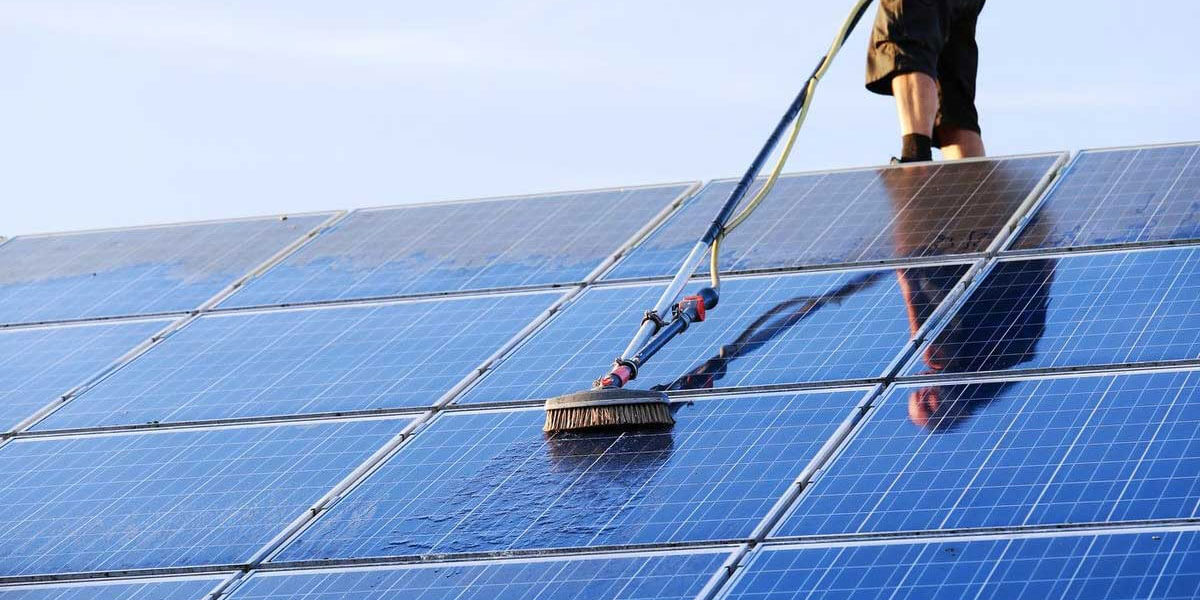
- Work from the ground with a water-fed pole and a soft brush. Telescopic poles reach most single-storey arrays.
- Pick a cool, overcast morning. Panels should be cool to the touch.
- Rinse loose grit off before any brush touches the glass.
- Brush gently with plain water. Add a few drops of dish soap only where something is actually stuck. Never scrape with metal.
- Rinse and squeegee dry, or use deionised water and let it evaporate.
- Never stand on a module. Silfab’s manual: “Do not stand on, drop, scratch, or allow objects to fall on the modules.”
Small garden fixtures are a different job with different rules — plastic lenses, no tempered glass, no warranty at stake: see cleaning solar panels on garden lights.
When to hire someone
Any array you cannot reach safely from the ground. Expect $8 to $20 per panel, or $150 to $500 for a typical 15 to 25 panel system, with around $325 the common figure. A second storey or a steep pitch adds $50 to $150. Ask two questions before booking: do you use deionised water, and what pressure do you work at? A contractor who answers “pressure washer” is the one who costs you a warranty claim.
Sources
- Mejia & Kleissl - Soiling Losses for Solar Photovoltaic Systems in California, Solar Energy 95 (2013) escholarship.org Every soiling figure in this article: 186 sites, 0.051% loss per dry day, a quarter of sites above 0.1%/day, the 0.1-inch rainfall threshold, tilt under 5 degrees soiling five times faster, 7.4% over a 145-day drought, and the +0.81% annual gain from one well-timed wash
- IEA-PVPS Task 13 - Soiling Losses: Impact on the Performance of Photovoltaic Power Plants (2022) iea-pvps.org Anti-reflective coating abrasion at 10,000 brush cycles against 3,100 with sand present, nylon brushes damaging more than polyester, the deionised or rainwater requirement, and global soiling losses of 3-4% of annual PV production
- Silfab Solar - SSI-13 installation manual and Limited Warranty Rev Q silfabsolar.com The 100 psi maximum, the ban on sodium hydroxide, benzene, nitro-thinners, acid and alkali, the ammonia-free pH-neutral glass cleaner allowance, the instruction never to stand on a module, and the warranty exclusion for cleaning outside the manual
- Canadian Solar - PV module installation manual v3.3 static.csisolar.com The 4 MPa (about 580 psi) limit, the pH 6-8 low-mineral water requirement, the instruction to avoid the hottest hours, and the two explicit warranty voids - inappropriate cleaning procedures, and rubbing dirt away dry
- REC - Alpha series installation manual (IEC edition, Rev 18) recgroup.com The outright prohibition on high-pressure hoses, the deionised-water-only requirement, the thermal shock warning, and that acidic or alkaline detergent may not be used - none of which appear in REC's North American edition of the same revision
- US DOE / FEMP - Solar Photovoltaic Hardening for Resilience: Wildfire energy.gov Production drops of 9.4-37.8% at Western US sites during smoke events and up to 58% locally in California in September 2020; the prohibition on window-cleaning products; and the 554-716F thermal-stress fracture threshold for tempered PV glass
- US Consumer Product Safety Commission - Consumer Product-Related Injuries and Deaths in the United States (2026) cpsc.gov An estimated 273,000 emergency-department-treated injuries involving ladders and stools in 2024
- Con et al. - Falls from ladders, Journal of Surgical Research 191(2) 2014; and Liasidis et al., J Trauma Acute Care Surg 93(3) 2022 pmc.ncbi.nlm.nih.gov An average fall height of 9.8 feet with two-thirds happening at home; and across 168,227 National Trauma Data Bank ladder-fall patients, 21.5% needing intensive care, 1.8% in-hospital mortality, and the discharge outcomes for patients over 65
Questions people ask
What should you not clean solar panels with?
Pressure washers, abrasive brushes or pads, metal scrapers, and anything acidic or alkaline. Silfab's manual bans sodium hydroxide, benzene, nitro-thinners, acid or alkali and other chemical substances because they damage the anti-reflective coating and void the warranty. Never brush dry glass either - Canadian Solar warns that rubbing dirt away dry causes micro-scratches and voids its warranty. Water, a soft brush and mild dish soap are the whole list.
Is Dawn dish soap safe to clean solar panels?
Yes, in small amounts. REC's manual permits a mild, biological and biodegradable washing-up liquid, and Mission Solar allows a mild non-abrasive detergent. Use a few drops in a bucket, apply only where something is genuinely stuck, and rinse thoroughly. Dried soap film attracts dust and will cost you more output than the dirt you removed. For ordinary roof soiling, plain water does the job on its own.
Will vinegar clean solar panels?
It will, and you should not use it. Vinegar is dilute acetic acid, and module manuals rule acids out: REC states that acidic or alkaline detergent may not be used, and Silfab lists acid or alkali among substances that may damage the anti-reflective coating and void the warranty. Vinegar also leaves a residue that has to be rinsed off. Nothing on a rooftop panel needs more than water and a soft brush.
Is Windex OK to clean solar panels?
No. Windex is ammoniated, and Silfab's manual permits only ammonia-free, pH-neutral glass cleaners. The US Department of Energy is blunter: do not use cleaning products traditionally used for windows, as they will increase the reflectivity of the modules' surface and reduce their efficiency. Raising reflectivity is precisely the opposite of what a panel needs - the coating exists to reduce it.
Is it safe to clean solar panels with a pressure washer?
No. Silfab caps cleaning water at less than 690 kPa (100 psi) and Canadian Solar at 4 MPa, about 580 psi. The cheapest consumer pressure washer starts near 1,300 psi. REC's manual forbids high-pressure hoses outright. Exceeding the stated limit can drive water past the frame seals, and every manufacturer's warranty excludes damage from cleaning done outside its manual. A garden hose at 40 to 80 psi is enough.
How often should you clean solar panels on a roof?
In most of the US, effectively never - rain does it. A study of 186 California systems found 0.1 inch of rain restores a tilted array to clean, and soiling costs only 0.051% of output per dry day. Wash once mid-season if you have a long rainless summer, live near farmland or desert, or after a wildfire. Otherwise clean only bird droppings, lichen and sap.
Will WD-40 clean solar panels?
No, and it makes things worse. WD-40 is a petroleum-based water-displacing solvent that leaves an oily film, and that film holds dust far better than clean glass does. No module manufacturer approves it. Jinko's manual is explicit that chemicals should never be used when cleaning modules, as this may affect the module warranty and energy yield. Water and a soft brush are the approved method.